Content Notes: Discussion of Child Murder, Misogyny and Mutilation
In my previous two articles, we have discussed the origins and a myriad of possible interpretations for the tale of Kuchisake-Onna. However, the feminist themes of this mythical character have had more ink spilled than any other framework. So join me, as we uncover the femininity of Kuchisake-Onna and if her story can help you too.
Objectifying Subjection
We are all familiar with the idea of beauty being tied to goodness. It’s a form of Halo Effect, where a desirable attribute leads to us misjudging a person’s character or actions.[1] Essentially, since attractiveness leads to our initial impression of a person being favourable, this frames any future judgement in a complimentary light. However, when the Halo Effect meets femininity, there is an unusual cross section. Because attractiveness in women comes with benefits and equal drawbacks.
In standard philosophy there is the object and the subject. The object is an entity which is perceived but cannot observe, and the subject is that which perceives others. When we talk of women being objectified, this is what is meant. A woman is, by most standards, a subject capable of perception and judgement. But within certain media portrayals she is relegated to an object, to an item for the (usually heterosexual male) characters and audience to perceive without having to consider her view.
An object also lacks agency. They are incapable of enacting or interacting with the world in any meaningful way. To be objectified is not simply to be admired as if you were a crass statue, but also to be denied your ability to act. This can be as straightforward as a piece of media disregarding a woman’s desires in a story. Or as blatant as the authorial approval of the character being dominated or possessed by a man.

Retrieved From: IMDB
Whilst this objectification can happen to any woman in media, it is most apparent with those deemed attractive. In books this creates the “Breasting Boobily” phenomenon, where the sexually attractive features of a woman are constantly highlighted, to the point of absurdity. In film and TV, this is accomplished by cameras lingering over the desirable parts of the character, focusing and framing their sexual attractiveness as their most important aspect. In art it results waist to hip ratios that would make insects blush. An attractive woman’s identity comprises only her physical form, that which the audience can instantly perceive, rather than any other characteristics or facets of personality.
With Kuchisake-Onna, part of her horror comes from firstly conforming to these expectations and then subverting them. Her beauty creates a Halo Effect and places her as an object within her own story. She is considered to be harmless or even virtious by the target. In addition, she is usually admired solely for her beauty. Like a piece of street art, the narrative regards her as something to be lecherously enjoyed. Some stories even portray her as a sex worker, a group known explicitly to face dehumanising objectification.
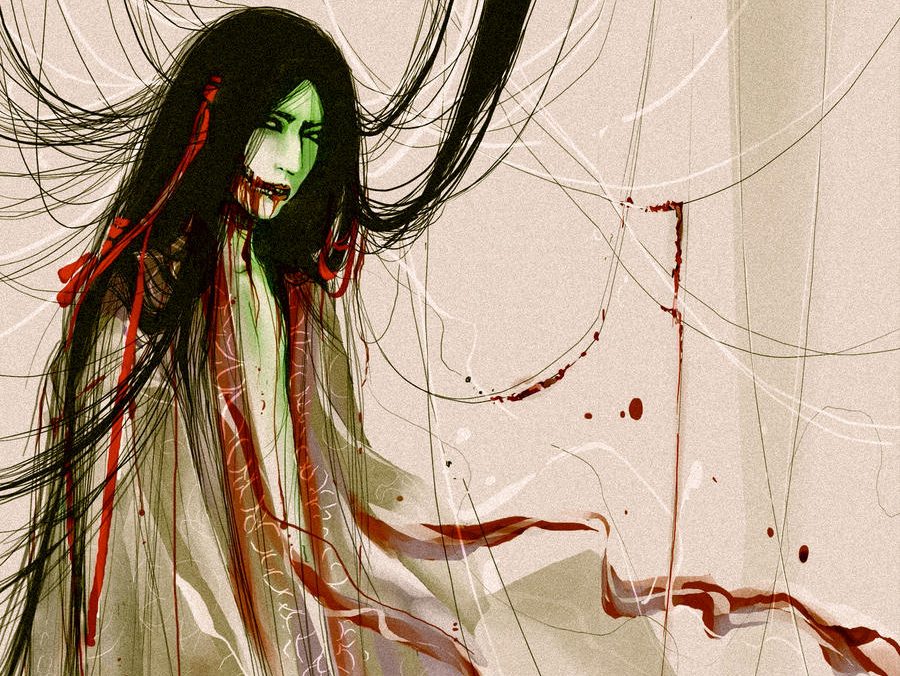
But with the revealing of her slit mouth, Kuchisake-Onna goes from an object of desire to a subject enacting sadism. The narrative switches, transforming her into the one who is perceiving her victim. She delights in her macabre questioning and the slaying or “improvement” of the object. But this not only changes her status in the story, but the entire perception of her character.

Retrieved From: Deviantart
The Halo Effect disappears as her true form is revealed and she becomes monstrous. I understand some people have…intense feelings about the slit mouth woman. But the most pervasive and intended narrative is one in which the carnal appetite of the victim and audience are rebuked. She becomes an active agent against the desires imposed upon her. And therefore becomes a horrifying subversion of narrative expectation.
Unwomanly Virus
Barbara Creed argues in the The Monstrous Feminine, that femininity is deemed as evil because although it is feebler than masculinity, it’s framed more carnal and without restraint. [2] She contrasts this with Julia Kristeva’s idea of “The Clean and Proper Body”. This is a symbolic body that all should strive to achieve, one of artifice, that exhibits no sign of natural degradation. Creed states this symbol is particularly difficult for feminine bodies to maintain, due to the trials of motherhood, puberty and loftier sexist standards. But if one can accomplish this task, you then become the pinnacle of artificial femininity, devoid of the usual degrading associations.
Obviously Kuchisake-Onna’s body, particularly the slit mouth, automatically excludes her from such ideals. But it is within a method of wounding her victims that a more unusual connection can be revealed. When answering her questions with “yes” both times, most stories say she slices the person’s mouth with her scythe, granting them her trademark look. A direct interpretation would be ironic punishment. For saying she is pretty, in a morbid way, she makes you pretty too. You could extend this further saying that the punishment for appeasing vanity is to have your own beauty marred. To fawn and placate such ideals allows them to ruin you.

Retrieved From: Instagram
But using the idea of The Clean and Proper Body, we can see Kuchisake-Onna as a defeminising monster. The threat of carving a person’s face is not just an attack on bodily integrity. For women, it is an assault on their Clean and Proper Body. The slashing of their face not only renders them as hideous as Kuchisake-Onna, but as defeminised as her. They lose a core part of their identity. Their gender. Or at least, the way they have been able to express their gender until now.
When paired with the Halo Effect, to have your attractiveness and body scarred becomes a mark on the entirety of your life. Your goodness is lessened. Your social status tanks. Even your personality could drastically change due to how you’re treated in the aftermath. The threat of a slit mouth for women is a complex intertwining of societal and physical repercussions.
But even more so, it shows the fragility of such concepts. Like glass, the idea of a Clean and Proper Body is pristine and beautiful. But also cracks under the slightest amount of pressure. A fundamental chip in such a body becomes a pox, an indelible sign of ruin that cannot be revoked. The horror for women is not solely in death. But in the idea that the sexist ideals they must take on to survive can be freely broken. It takes one accident, one problem, a isolated event going wrong and their body shatters. With one mistake they cannot control, they become Kuchisake-Onna.
A Monstrous Femininenon
In her essay, Monstrous Women, Dianne Taylor posits that women become monsters when they fail to be feminine.[3] Taylor relates this to the fact women are less likely to receive the death penalty in the USA, arguing it is not solely benevolent sexism. Instead, for any one woman to be considered for the death penalty she must be:
“incorrigible, irredeemable because she is thoroughly immune to refeminization —a monster”
In her eyes, immunity to re-feminisation is monstrous because of how it violates both biological and social laws. Using the works of Foucault, she states that key to the judicial power of modern governments is the idea that individuals can be corrected, usually through punitive measures. But to be corrected one must accept a norm to follow, an ideal standard of what it is to be good. For men and women this is different, but frequently relies on the reuptake of gendered norms. And especially for women, biological and personality based norms intermingle as if they are one.
A woman is not separate in character to a man because of environmental factors, at least according to dominant social narratives. Instead, it is her [Insert Relevant Pseudoscientific Explanation]. Whether it is wandering womb, the curse of oestrogen or that pesky underdeveloped pre-frontal cortex, a sexist society will always find a way to justify women’s supposed inferiority. And if a woman is smarter, more athletic, more rational or otherwise supersedes men in masculinity? Then she is showing the fragility of such norms. In refusing to go back into the feminine domain, she is violating both biological and social truths that society is built upon. [3] And becomes a monster to society at large.

Retrieved From: Wikipedia

In this way, we can identify how Kuchisake-Onna violates these cornerstones. Whilst undeniably irrational, she is always portrayed as outcompeting men in athleticism and sadism. In doing so, she establishes her dominance over men quite easily, capable of inflicting bodily harm in a way foreign to most of them. As well although not traditionally smart, her manipulative tactics demonstrate how she can outsmart men by undermining their expectations of logical answers. This contradicts ideals of rationality, causing a terrifying breakdown in the norms of conversation which may end up in an unfortunate demise.
In addition part of the horror is in the lack of explanation for her violations. There can be comfort gained from developing an understanding of how a person would break away from norms. These explanations do not need to be true, instead they merely have to contain enough verisimilitude to placate the person’s fears. It is never explicit stated if Kuchisake-Onna is just a hysterical woman, a supernaturally powered ghost, a demon or anything else. By never having a apparent grounding of who or what she really is, a sense of safety in knowledge is impossible to reach. Therefore, the person is confronted with an unknowable dread for a humanoid monster they will be impotent to fully comprehend.
Slicing The Glass Ceiling
But we can get even more specific with Kuchisake-Onna’s breaking of normative ideals. Ryden Shartle provides an excellent summarisation of the history of feminism in Japan.[4] This additionally provides a detailed background for the specific sexist norms perpetuated in 20th century. The 1920s saw a frequent scientific rationalisation for women performing housework, domestic hygiene and other activities, for the betterment of the Japanese people. This selflessness as feminine virtue was expanded in the 30s, with women being corralled to volunteer in making care packages and performing nursing duties in the army.
Next (hopefully shocking no-one) there was the US occupation. This saw a time period where women were provided more rights, in hopes of instilling fewer sexist values…Oh wait, sorry I got that wrong. It was in the hopes of limiting Japanese military power. Lovely. After the US left, the Japanese government focused on reversing this and encouraging feminine education. This sounds pleasant, but it was principally activities like home economics and flower arranging. The idea behind this is that by having separate spheres for men and women, Japan would catch up with the US. One can provide for the home, and the other can provide valuable work, therefore maximising efficiency.
Before the 70s, a lot of Japanese feminism even exemplified sexual differences, focusing on women’s roles as mothers and caretakers to gain more rights.[4] But then came the Ūman Ribu movement, a transliteration of women’s lib. Combining international thought with Japanese feminism, the Ribu movement was the first time that women sought to challenge men’s cordoning of roles in a unified manner. This revolved around radical feminist challenges for what it meant to be a woman in Japanese society. As well as the role they could play both individually and within the society. Which is around the same time a certain folkloric monster began to rise to prominence.

Retrieved From: Deviantart
As opposed to selfless virtuosity, Kuchisake-Onna seems entirely rooted in selfish sadism or malicious madness. It is never fully expounded on, but through various texts and writings, the common through-line seems to be that she is just a cruel monster. It is her nature, either through jealously, spite or misanthropy to injure others with no feminine motive. In fact, as commented on by Taylor, the act of sadistic murder is itself considered to be masculine.[3] To delight in harm, to enjoy the process and to come out the other end unforgiving, is counter to any ideals of feminine selflessness.
As well her actions are complete opposite to the idea of a maternal figure. Not only in the evident sense of being a murderess but in being outside of the home, usually in metropolitan areas. Places where it is expected to predominantly witness men at or leaving work. Her mere presence in such a place is a disturbance of the isolated spheres for men and women. In the act of not only existing, but overpowering men within these spaces, she represents a complete reversal of the natural societal order. An uneasy contradiction by her very existence.
This fear is exacerbated by the fact that the Ribu movement at the time was pioneering such changes. They urged women to occupy men’s spaces in radical ways that deliberately destabilised the sexist ideals that restrained them to the home. But to the men experiencing this destabilisation, considering their security was built on the labour and isolation of women, I’m convinced it looked contiguous to the myth of Kuchisake-Onna. An opinion reinforced by the fact that her tale was largely spread due to male owned women’s magazines sensationalising the story. [5] In a way, her tale can be seen as spreading due to the feared threat and irrelevancy of masculinity at the time. She, like the Ribu feminists, was an inoccent seeming woman attacking masculinity in the very sphere it was meant to propogate.
Popularity Contests
Through all of this discussion, you may have gotten the impression that Kuchisake-Onna can be an imperfect feminist icon. That her story of bucking feminine ideals, representing feminist movements and becoming her own subject is empowering. Well, I am not going to fully deny that interpretation. Part of my love of Kuchisake-Onna is because she represents a lot of what I enjoy in stories. She’s a monstrous woman, a biological freak of nature that weaponises her perceived deformities and femininity against the tropes that would imprison her. It is not without merit to recognize something significant and relatable in her tale.
However, as pointed out by Dianne Taylor, such stories are frequently to the benefit of a sexist society. [3] The violation of norms does not sever them; it instead enables them. Through the monster, a person can justify previous prevailing norms, using the event or story as an argument against the removal of them. As much as I’d love the re-interpretation of Kuchisake-Onna to be more powerful, it is never going to outdo the most conventional narrative. Her tale was, in part, propagated by men and mass media as a way to castigate and shame women. In particular feminists.
Therefore, even if we as individuals can see Kuchisake-Onna in this way, it would be challenging to reform how most media explores her. I have read through dozens of articles about Kuchisake-Onna, and the non-academic ones invariably portray her as a freak.[6][7][8][9] Even more so, these articles barely mention much of the alternative interpretations of her story. Instead distributing one version of the tale they deem to be the most horrifying and clickbaity. Because complexity is difficult to grapple with. It has taken me over a month to produce a bare minimum amount of research to provide some varying perspectives. And I like reading academic papers.

Retrieved From: Deviantart
This can be seen with other mythological characters as well. I’m certain those reading this will likely be familiar with a plethora of interpretations about Medusa. But, ask most people who aren’t history nerds (or sapphic), and the invariable response will be that she is a villain. An object for the projection of sexist tropes where she is to be slain by a man because she is a monster. Such stories are usually engrained in pop culture. Unless someone wishes to undertake the work to dig deeper, they will never get to the other sides of these narratives.
But that is not to say we are without hope.
A Case For Monsters
Shartle recounts how the Ribu movement focused a lot of work on filicide. [4]At the time, Japan was facing an unprecedented reporting on women killing their children. These mothers were vilified and routinely lambasted as inhuman. But Ribu figures like Yonezu Tomoko argued that whilst filicide can never be condoned, one should blame societal conditions rather than the mothers. These women were often marginalised and desperate. Whether it be poverty, abuse, untreated mental health issues or any other variety of vulnerability. Society failed to care or aid them in any capacity. Therefore, instead of dehumanising, we should empathise.
To shift the narrative that pits monstrous women as unfeminine, one should not exacerbate the contrast but soften it. By influencing people to empathise with the socially deemed worst of the worst, we can directly threaten and destabilise the sexist tropes that prop them up. Even personally I have seen the efficacy of this. In talking to mothers within my life, the discussion of maternal filicide has come up. And often promoting empathy with these filicidal actions not only helps promote understanding, but allows them to tackle internalised sexist ideals towards themselves. In inviting people to care for a “monster”, they are allowed to realise they too are not a monster.
Unfortunately, folkloric tales like Kuchisake-Onna end up being too abstract for people to empathise with her. An individual cannot interview Kuchisake-Onna. You cannot witness her crying because of what happen. Nor can you ever follow her consistent growth and change. It is the strength and weakness of folkloric myths that they are shorter and often personalised tales. Weaved to the society, social groups and individuals interpretations of what the tale is.
I truly believe there is power within stories, but to utilise it we must pick the tales people can relate with. In inciting individuals to examine the monsters society generates, a person can more clearly see themselves in the imposed stigmatisation. Moreover, you can follow the person’s own narrative. How they felt, understood and reckoned with their actions. In essence, you can humanise a monstrous human more than a folkloric figure. And doing so demonstrates that monsters are not real. They exist solely in stories but are transposed onto real life, to constitute a convenient scapegoat for societal ills. In making a case for “monsters”, we make a case for the liberation of all of us.
Thank you for coming with me on this journey. I hope you enjoyed this mini series on Kuchisake-Onna. I will be back with some musings on one of my favourite poems in a fortnight. Until then, let me know your thoughts below!
References
- Wikipedia Contributors. (2019, April 18). Halo effect. Retrieved from Wikipedia website: Wikipedia
- Creed, B. (1993). The Monstrous-Feminine: Film, Feminism, Psychoanalysis. London: Routledge
- Taylor, D. (2010). Monstrous women. PhaenEx, 5(2), 125-151.
- Shartle, R. (2023). Motherhood, Femininity, and the Body: Reading Representations of the Feminine in Kuchisake-onna (Postwar Japan) (Master’s thesis, Arizona State University).
- Michael Dylan Foster. (2009). Pandemonium and Parade. Univ of California Press..
- Dowell, C. (2024). The Legend of Kuchisake-onna: Japan’s Slit-Mouthed Woman. Retrieved from: Medium.com
- Unknown Author. (2024). The Legend of the Kuchisake-onna: The Slit-Mouthed Woman in Japanese Urban Legends. Retrieved from: Mythology Worldwide
- Harvey, A. (2023). Kuchisake Onna: The Vengeful Japanese Spirit That Attacks Victims After Asking “Am I Beautiful?” Retrieved from: All Thats Interesting
- Meyer, M. (2024). Kuchisake onna | Yokai.com. Retrieved from Yokai.com website: Yokai.com
Leave a Reply