If, like me, you watch far more anime than is healthy you are likely familiar with Kuchisake-Onna. Directly translated into English as the Slit-Mouthed Woman, she is a beautiful being who at first looks human, but soon reveals her true ugliness. I, like many, believed that this story came from far back in the annals of Japanese history. However the origins of Kuchisake-Onna, are not so cleanly sliced
Understanding the Story
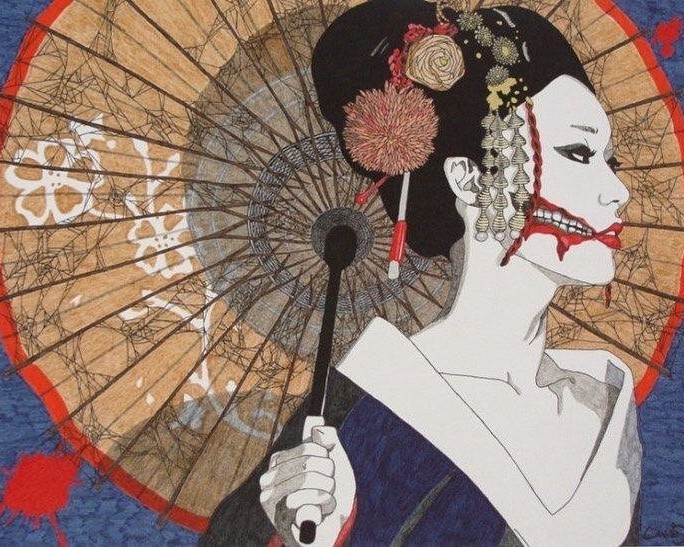
The story of Kuchisake-Onna has some variations depending on the version, but all follow the same fundamental idea. A woman was killed by having her mouth slit, usually because she cheated on her spouse or had plastic surgery. However, death proves to not be the end, as she rises once more as a vengeful spirit. In this form, her slit mouth is concealed by something be it a fan, handkerchief or surgical mask. In addition, she now wields a sharp object, usually a scythe but it can be a knife or even scissors. As part of her vengeance she seeks isolated people, usually men or boys, on dark nights and asks them a simple question.
“Am I pretty?”
Most people would reply yes, but those who decide to respond negatively are swiftly slain. But should you be affirmative, a second question is asked, punctuated by the revealing of her disfigurement.
“How about now?”
If you say no, she will slice you with her scythe. If you say yes, she will make your face as pretty as hers. Rather horrific right? There are ways to be spared, though it changes with every telling. Some say that pomade, or hair wax, can ward her away. This is to the point just chanting pomade three times can get rid of her. Others mention throwing candy or offering it to her will satisfy her bloodlust. There’s even versions that suggest you simply answer yes twice, although I would not personally risk it.

Retrieved from:Wikipedia
Pinning Down An Origin
When first researching this, you will come across a variety of webpages attributing the tale of Kuchisake-Onna to the Edo period, that is from around 1600 to 1853. [1][2]. In fact one article even reported that it existed in the Heian period, around 784 to 1185. [3]. However when reading these accounts, you will notice something quite plainly. There is literally no academic evidence given to support such a conclusion.
So next, you would turn to the bastion of academic integrity itself. Wikipedia. The site lists two possible origin points, the Edo period and the late 20th century [4] The former hypothesis is referenced with two pieces of data. An image from the 1801 book Ehon Sayo Shigure by Hayami Shungyōsai and a blog post on Kuchisake-Onna by folklore illustrator Matthew Meyer:

Retrieved From: Wikipedia
“During the Edo period, a large number of Kuchisake-Onna attacks were blamed on shape-changed kitsune playing pranks on young men.” [5]
Ehon Sayo Shigure is nearly impossible to obtain, but there is some second hand reporting I will touch on later. However Meyer, never actually references any account to back up his claim, so we can somewhat discount it. Though I do have an idea that could explain it. But to do so I need to take you to the beginning of Kuchisake-Onna. To a grander, more innocent time long forgotten by all but the oldest soul. An ancient period of humanity shrouded in mystery.
1978.
The Elderly Modern
As reported separately by folklorists Iikura Yoshiyuki [6] and Michael Foster [7], the first textual reference to the tale of Kuchisake-Onna was in December 1978. Specifically, it was the story of an elderly woman, living in a rural area of the Gifu prefecture. At night, she saw a slit-mouthed lady standing in the corner of her garden, who disappeared without a trace. Yoshiyuki goes on to speculate that the propagation of the myth started with children in the prefecture who intermingled in the new juku or preparatory classes. This led to a cross section of class and geography that had never existed, allowing such a captivating myth to mutate and spread. Journalist Asakura Takaji argues it may have been used to scare lower income kids from even attending these jukus[8].
On top of this, Foster argues the tale captivated the minds of adults, with women orientated magazines at the time being absolutely crucial in relaying it to a maturer audience. The reach of Kuchisake-Onna was so rapid that by May 1979, it was in national news and there are records of her story within every prefecture. And this is pre-internet times, that is an astounding level of expansion and adoption for a folkloric tale.
But if we are to believe that Kuchisake-Onna originates within this period, we would need an explanation for why it is tied to the Edo period. Foster argues that folklorists like Noboru [9] and Shigeru [10] tied Kuchisake-Onna to previous mythological women. This was not to just suggest a simple link in how stories often have archetypes and repeating narratives but instead as Foster puts it:
“ ..based on a genealogical line of demonic women or some essentialist female nature…”
In other words Kuchisake-Onna is treated as a inextricably tied to Edo period yōkai, in that she is the continuation of these stories. This leads to a muddying of her origin. Instead of being clearly created in the 70s, she is treated as a figure in mythology who has eternally existed. The latest story is relegated to a mere modern retelling. This becomes even more apparent when Shigeru ties Kuchisake-Onna to Iso-Onna, a tale of siren like women, by drawing the Iso-Onna with a slit mouth in his books. This attempts to recreate Kuchisake-Onna as a Edo myth, a titan of folklore. All of this, serves to confuse and muddy the water, leading to articles assuming that Kuchisake-Onna is directly from in the Edo Period. Or even that it can be confused with kitsunes.

Though this is convincing, I don’t believe it to be the whole story. Whilst it is true that Noboru and Shigeru connections are shaky at best. There are real connections to Edo period mythology, which albeit not named Kuchisake-Onna, at least helped greatly to inspire the modern myth.
Painting A Clearer Picture
I previously mentioned an artwork by Shungyōsai from his book Ehon Sayo Shigure. Ehon is essentially a term for the type of publication, relatively similar to a picture book where art occupies most pages accompanied by text. The text alongside this drawing is part of a story. It describes a man who goes to procure adult services, and discovers a woman within the local hotspot [10]. The woman seems gorgeous although he can only see her back.
However when she turns, a slitted smile is revealed, that goes from ear to ear. This causes the man to faint and the woman is never seen again. A similar tale exists in Hirachika’s story from the mid 1700s, although in this version, a man dies from shock.[11] These appear to be the first textual references to a slit mouthed woman in Japanese mythology, though they do not share the name of Kuchisake-Onna. Whilst the distinctive smile is certainly similar, the narrative around it feels far removed, apart from the surprise reveal. But these are not the sole examples of possible precursors.
The next story comes from the Gifu prefecture. A woman tries to cross a mountain pass to visit her lover.[12] However, to stave off the danger of ne’er-do-wells, she bears a sickle and holds a crescent shaped carrot over her mouth. On it’s own this shares some vague similarities. But let me include some historical context. In 1754 the Gifu Prefecture, then the Mino Province, was the site of a farmer’s revolt known as the Gujo Uprising. [12] As you can imagine the event was a bloody affair, that prompted tales of vengeful spirits of the farmers who had been slain. It is possible the imagery of two local myths could have ended up intermingling. The spirit of a vengeful woman carrying a sickle, fawning for love and possessing an unusual facial feature. All of this helping invent the story of Kuchisake-Onna.
Further more, some of the ways to deal with Kuchisake-Onna harken back to previous mythology. Pomade contains mugwort, a plant used as a ward against malevolent spirits. The chanting of pomade three times evokes the rituals of Shintoism. Even the candy trick was formerly used in stories of Ubume, the spirits of pregnant women who (in one version) wished to get sweets for their unborn children.
Overall, a lot of Kuchisake-Onna’s tale appears to be piecemeal inspired by a variety of folklore that came before it. So whilst Kuchisake-Onna, as we now recognize her, definitely started in the 1970s. The story undeniably drew heavily from folklore of the time, as well as the events of the local culture.
A Slice of Truth
From all this inevitably follows the question. Why? Why would academics focus on ephemeral connections to kitsune and Iso-Onna, when real connections to actual Edo period mythology exist? In a word.
Prestige.
Foster mentions how Shigeru in particular fosters comparisons between himself and the legendary Edo period illustrator of folklore Toriyama Sekien. Sekien’s drawings of bizarre figures are some of the most well-known both within and outside of Japan. It is unfortunately common within all forms of academia that people are rather one track minded, making connections based on pre conceived notions of the research they are conducting.
If scholars like Shigeru focus on the prestigious folklorists of the period, then it will be easy to miss the more humble connections. And the opposite occurs too. When academics decide to counter investigate the claims, they focus on completely discrediting the idea. Because a more nuanced “yes but no” is simply less interesting to their fellows and popular media.

I, myself, am not immune to this. In writing this essay, I started with the notion that I was going to be about how academics falsely created a connection to folkloric figures. That I was untangling a web of bias against urban legends in favour of more widespread classical myths. Though I believe it is a factor, it’s undeniable that there are genuine historical connections that were missed by Foster and Yoshiyuki. By trying and break down hypotheses lacking evidence, I almost overlooked a rich cavalcade of local and national history. All in the hopes of an exciting essay that devoid of any nuance.
Because in all honesty, the real-life conclusion is a little boring. Of course an urban legend takes inspiration from previous myths and actual events. And whilst the details are fascinating to me. It’s a lot less salacious than academics deliberately lying due to bias or talking about how traditionalism obscures the beauty of modern tales.
Even so, ultimately the truth of Kuchisake-Onna’s origin really does matter. The preceding stories that inspired her, as well as the unique historical context at which it arose, all inform how we can understand and interpret the tale. Without this knowledge, any analysis will be unable to articulate what captured the imagination of the people, and what ushered it as a viral hit before the internet existed. But that is a story for another time.
I hope you enjoyed this essay on the origins of Kuchisake-Onna. I look forward to discussing the many ways she can be elucidated. Until next time!
References
- Dowell, C. (2024). The Legend of Kuchisake-onna: Japan’s Slit-Mouthed Woman. Retrieved from: Medium.com
- Unknown Author. (2024). The Legend of the Kuchisake-onna: The Slit-Mouthed Woman in Japanese Urban Legends. Retrieved from: Mythology Worldwide
- Harvey, A. (2023). Kuchisake Onna: The Vengeful Japanese Spirit That Attacks Victims After Asking “Am I Beautiful?” Retrieved from: All Thats Interesting
- Wikipedia Contributors. (2019). Kuchisake-onna. Retrieved from: Wikipedia
- Meyer, M. (2024). Kuchisake onna | Yokai.com. Retrieved from Yokai.com website: Yokai.com
- Yoshiyuki, I. (2019). Japanese Urban Legends from the “Slit-Mouthed Woman” to “Kisaragi Station.” Retrieved From: Nippon.com
- Michael Dylan Foster. (2009). Pandemonium and Parade. Univ of California Press.
- Asakura, T. (1989). Ano kuchisakeon’na no sumika o Gifu sanchū ni mita’“uwasa no hon” Takarajimasha
- Noboru, M. (1985), Yōkai no minzokugaku: Nihon no mienai kukan(Iwanami shoten), 22–27.
- Shigeru, M. (1984). Zoku yōkai jiten (Tōkyōdō Shuppan).
- Kondo, M. (2002) “Hyakki Ryoran: Edo Kaidan and Y . (2002) Hyakki Ryoran: Edo Kaidan and Yokai Ehon Shusei” , Kokusho Kankokai; Hayami, S. “Ehon Sayo Shigure”; (originally published in 1801)
- Shibata, S. (2008) ed., Dictionary of Strange Stories and Irregular Stories; Hirachika, T. , “Kaidan Oro no Cane” (originally published in the Horeki Period)
- Hayakawa, K. (2008) Kowai hanashi – anata no shiranai Nippon no “kyōfu”, Mirion Shuppan
Leave a Reply