Content Notes: Discussions of Colonisation, Homophobia, Incest, Pathologisation of Women, Sexual Assault and Rape
Christina Rossetti’s Goblin Market is a classical piece of feminist poetry. Admired by many women, especially with the rise of second wave feminism, it has spawned numerous intellectual discussions about the experience of femininity in Victorian England and beyond. It was also quoted in one of the best episodes of modern Doctor Who, which is how I initially came to learn about the poem. So join me, as we take a peek into the historical context behind the Goblin Market.
The Beginning of A Market
Christina Rossetti was born in 1830 within London. [1] Her father, Gabriel, was a well-known poet and her mother, Frances, is most known for being related to famous people, according to Wikipedia.[2] Her family was filled with creative people, like her uncle John Polidori who wrote The Vampyre, considered to be one of the first modern vampire story. [3] She was somewhat of a prodigy, being first published at the age of 12, proving that anyone can be an acclaimed pre-pubescent author. If you have a grandfather with a publishing company. Truly the Christopher Paolini of her time.
Goblin Market was published in 1862, although drafts had been being made in at least 1859.[4] I am going to provide a brief overview as to the plot, and will have snippets where necessary, but I encourage you to read it in full. Like all poems, the experience of reading Goblin Market add to the perspectives and will provide necessary context for interpretations. If reading is not your style then there is an audio version of the tale featuring excellent voice acting by Shirley Henderson.

Retrieved From: Apollo Magazine
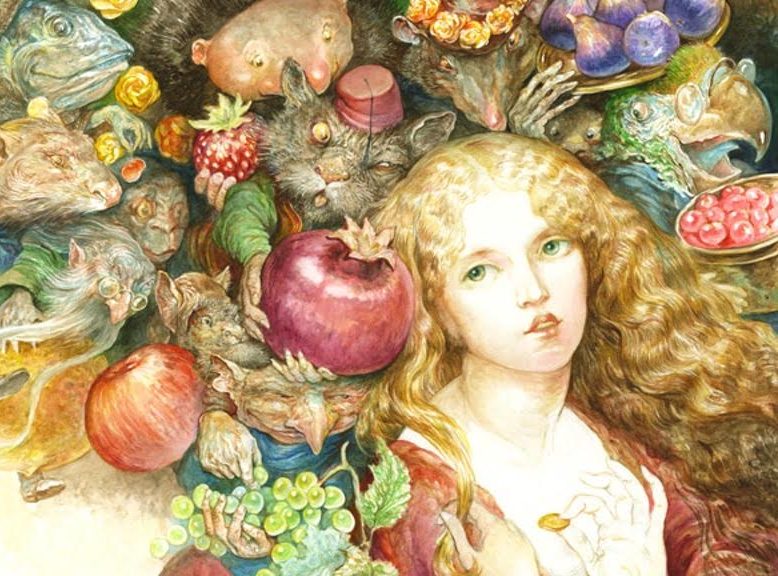
Our story begins with two sisters, Lizzie and Laura. They live in a small Edenic cottage, isolated from the larger cities around. One day, as the two are venturing out, they hear the sounds of a goblin market in the woods nearby. Although Lizzie resists the sumptuous temptations, Laura is enamoured with the burgeoning fruits, despite her sister’s protestations. Laura indulges in the culinary delights; each described with lurid eroticism. All for the small price of a lock of hair. She eats till she can eat no more, stuffed and unable to tell night from day, before heading back to her Lizzie.
However, as time passes Laura becomes increasingly withdrawn. The first night without the fruits, she stays awake, gnawing and gnashing at the idea of the delights. She tries growing a seed from the leftovers of the goblin market but it never sprouts. Ultimately, Laura becomes completely devoid of life, her hair growing grey and overall is passive in demeanour. Worst of all, though Lizzie can still hear the goblin market, her desperate sister cannot. Lizzie is unable to bear this any longer. Therefore with a silver coin in her purse, she goes to the goblin market to obtain some fruit for her sister.
The trip is not as easy as she would like. At the start, the goblin men try enticing Lizzie to partake in a feast, though she is steadfast in merely wanting to buy fruit. The goblin men then hurl insults at her before resorting to assaulting Lizzie. The attack is portrayed a form of metaphorical rape, because although she is never sexually defiled, the description of the violation is carnally coded. Lizzie remains stalwart, never partaking in the fruit even as the juices drip onto her face. Eventually, the goblin men give up, throwing Lizzie’s silver coin back at her. Lizzie then runs back to her sister.

Retrieved From: Apollo Magazine
The revival of Laura is also quite sexually charged, but is much more rejoiceful. Lizzie bursts into the house, filled with ecstatic delight as she encourages her sister to:
“Eat Me, Drink Me, Love Me”[5]
Whilst the sisters never perform a wanton act, the two are in the throws of ecstasy. On top of which, Laura feels intense pain intermingling with her delight. They slurp and lick and bite and kiss, partaking in each others bodies like fruit. But after this trial, Laura is rejuvenated, transformed back to her old self once more. The sisters celebrate, with the poem ending by mentioning the two girls have become wives and Laura telling her kids the value of sisterhood.
There are many places one can begin needing to explain historical context, but the most important is likely the part that flies over the head of most people. That is unless you know “Eat Me, Drink Me, Love Me” is a reference to the Eucharist. Don’t worry I didn’t either until three papers in. When it was explicitly stated. Even though two of the papers employed the phrase in reference to religious interpretations.
But to discuss the religious roots of this poem in a later essay, I am going to have to talk about some history now.
Devouring Christ
Anglican is the term used to describe the Church of England, that is the majority religion of the UK. It was conceived after Henry VIII decided commitment was overrated and wanted to acquire a new wife. Lamentably, the Catholics rather despise the idea of divorce, so Henry VIII made his own denomination. This Church of England constituted part of the larger Protestant Reformation, which would require an entire essay to accurately dissect. All you need to know is England wasn’t the only one breaking away from the Italian church. Also, to my UK readers, I am going to use Anglican for ease instead of Protestant to refer to the Church of England and its adherents. Because although British Anglicans call themselves Protestants, that term comprises multiple subsections of Christianity.
When Christina Rossetti was writing, the Anglicans had been stable in England for a good 200 years. Minus that time we became Puritans and the Anglicans were banned. As with all religions, they began to be bored of the traditions they used. Specifically a movement called the Oxford or Tractarian Movement was brewing.[6] The Oxford Movement was spearheaded by some of the higher ups in the English Church, who believed Anglicans should move to a more Catholic oriented view of theology. It originated in a series of essays called “Tracts for The Times”, hence Tractarian. This resulted in the Anglo-Catholicism movement, which was a melding of the two worlds, as well as some Anglicans diverging to the Catholic Church.

Retrieved From: Wikipedia
However, the crucial point of contention that is of interest for us today is the Eucharist. This is when a person eats the Body of Christ and the Blood of Christ in the form of bread and wine. Or if you are a child, Vimto. The Eucharist comes about due to a section of the Bible called The Last Supper, where Jesus and his disciples eat bread and wine. Though accounts differ depending on which section of the Bible is recounting the story, emphasis is placed on the holy connection between Christ’s material form and the meal. In common Christian theology, Paul (one of Jesus’ disciples), then insitutes the Eucharist as a ritualistic celebration of God. But, because of differing accounts and time between the Bible’s writing and Victorian Anglicanism, there emerged two Anglican interpretations of the Eucharist.
First is Virtualism, the idea that presence of Christ in the bread and wine is purely spiritual and possessed no bodily substance. [6] Put differently, they are not consuming Christ’s body in any tangible way, but instead through the Eucharist are filled with the spirit of God. Conversely there was Receptionism, which focused on the worthiness and goodness of the person partaking in the Eucharist, as opposed to the food. In this way, God uses the bread and wine to commune with the person, so they otherwise intangibly recieve the Blood and Body of Christ. These two are clearly offering a more intangible (and frankly esoteric) interpretation of the Eucharist. But The Oxford Movement subscribed to another view.
To express it simply, they believed that when someone performed the Eucharist, they were eating the Body and Blood of Christ .However, it is not a straightforward case of psudeocannibalism. As Marylu Hill describes, the belief by Anglicans within the Oxford Movement was that the bread and wine represent God’s words made digestible to humans. [6] Practitioners at the time compared the Eucharist to breastfeeding mothers. Like a mother transforms food into milk for her baby to feed, so too does God formulate his love into a digestible form. Essentially, the bread and wine, were both materially food as well as the Body and Blood of Christ. They profoundly believed the Eucharist was soul food in a literal sense, capable of redeeming those who had lost their way.
But even more so, the Eucharist satiated people’s spiritual hunger. Around this time, many Anglican theologians were looking back at early Christian writers and being inspired by their works. And these works focused frequently on how the teachings of God, could satisfy the hunger of people in a way nothing else was able to. Edward Pusey, an important Anglican Theologian, focused on translating and teaching these interpretations. [6] In his translation of Saint Augustine’s writing is the following:
“But I hungered and thirsted . . . after Thee Thyself, the Truth . . .yet they still set before me in those dishes, glittering fantasies. . . .Yet because I thought them to be Thee, I fed thereon; not eagerly, for Thou didst not in them taste to me as Thou art; for Thou wast not these emptinesses, nor was I nourished by them, but exhausted rather.”[6]
From this we are able to tell that Saint Augustine, and by extension the Oxford Movement Anglicans, believed the world was teeming with fantasies that one can feed on. But those material indulgences are nothing when compared to the word of God, to his spiritual food that can fill our every want and desire. As I will talk about in the following essay, Christina Rossetti was absolutely inspired by Eucharist debates of the time. But first, lets get more specific about Rossetti’s Anglicanism.
Devoting Time
The history of Christina Rossetti is a relatively challenging thing to piece together. As reviewed by Mary Carpenter, the poet’s life around the time of Goblin Market is mostly relayed through her brother William. Unluckily, for us, William did not retain the most accurate recollection. He failed to recall the separate orders his sister Mary joined and did not know when Christina began carrying out social work. [4] Consequently, take the specifics of her with a pinch of salt. Furthermore, we will have to talk of the general institutions she was a part of since there is little reliable information on her personal life.
Christina Rossetti was involved consistently with her church, Christ Church, which she joined in 1843. [6] At some point before 1859, she began volunteering at the sisterhood adjoined to the church called All Saints Margaret Street. These sisterhoods were institutions for middle class Anglican women to volunteer and devote time to serving the working class. They were not religious orders like a nunnery, but rather open to all women who attended the church. Whilst some would focus explicitly on sex workers, All Saints seemed to utilize a more generalised approach. By the end of the 1860s, All Saints would have: an asylum for older women, an industrial school for girls, an orphanage and a nursing service.

Retrieved From: Art UK
Fun Fact: Rosa Corder allegedly made forgeries of Dante Rossetti’s art (Christina’s brother)
The church itself was a hotbed for social reform as well as for the Oxford Movement. Edward Pusey preached and lectured multiple times whilst Rossetti was known to attend the Church. So, as Mary Carpenter states, it is not unlikely she was exposed to these contemporary ideas.[4] Moreover Pusey was a significant proponent of social work through sisterhood, having been integral in the creation of All Saints. Although in Carpenter’s view, he saw the sisterhood as:
“A sanctified domestic enclave of perpetual daughters”[4]
To put it in simpler terms Pusey, and many men like him, viewed these sisterhoods in a rather patronising and patriarchal lens. The volunteers of All Saints, including Rossetti, were viewed by the higher ups as youthful innocents who’s religious purity would help to liberate fallen women.[4] But this perceived purity, also resulted in many male liturgists fearing for these sisterhoods. Some worried that by being exposed to sex workers, these women would rebel against their roles as subservient humble wives to men. Since sex work began through small rebellions against God, these middle class women would also fall into the same vices. An idea with a substantial basis in reality. [No citation found]
Those fears were part of a broader trend in English culture of disgust towards sex workers. The Contagious Disease Act of 1860, was the epitome of this fear, as it controlled and criminalised certain sexual activity due to worry over “degenerate hereditary” and syphilis.[4] Naturally, this was typically implemented against women’s sexuality, especially marginalised women. If you want to know how close to home that was for Christina, her brother Dante wrote a poem called Jenny. A poem which espouses the fear of sex workers diseased minds and contagious environments:
“For is there hue or shape defin’d
In Jenny’s desecrated mind,
Where all contagious currents meet,
A Lethe of the middle street?” [8]
But for the women working in these sisterhoods, it was a contrasting experience. The idea of social work sisterhoods originated with Florence Nightingale. Nightingale was a British nurse in the Crimean War, a war between Russia and France, with Britain allying with the French. All British people take a moment to expel your disgust. She was most known for her radical medical changes to wartime treatment, including insistence on cleaning the hospital barracks and disposing of waste products. Regrettably, these were revolutionary ideas for the time. Amongst these was another revolutionary idea, this time a more feminist one. The idea that women, even those who were unmarried, have worth in providing aid to people that cannot provide for themselves. Primarily if they work together in sisterhoods.

Retrieved From: Wikipedia
Nowadays, this idea can seem somewhat milquetoast, but it faced considerable backlash. Men at the time warned that single women working, especially together, would result in them being displaced from their “natural” position.[4] Additionally, this displacement would not just be unacceptable for sub-par men, but would also cause the fall of the British Empire! How awful, indeed. The idea that women can work together to uplift and transform the world, established such an impression on Rossetti that she tried to join Nightingale. And she was only turned away because she was too young. The idea of sisterhood and women being the ones to save each other, is evident in Goblin Market from even the most cursory glance.
However, I do want to conclude this section with a little bit of a reality check. Whilst these sisterhood orders, secular and religious alike, were revolutionary for the time. Do not misinterpret them as perfect bastions of care. To begin with, the emphasis of spiritual healing is an extension of common colonialist practices at the time. That through God (only the Anglican one, though) people can be made whole. And so, we should ignore or override other people’s spiritual and religious beliefs. Even more secular institutions can be rather impotent to soothe individuals mentally and spiritually, if it fell outside their view of Christian values. As well Anglican values were often weaponised against the people Britain colonised, usually as an excuse to not assist them. Or to only aid them with the condition of nominally appearing Christian.
In addition, this was an inherently classist system as it was always middle class Anglican women performing the care. And I am not against the prosperous devoting time and money to helping those less fortunate. However, these institutions perpetuated dehumanising rhetoric and did not allow the people most disadvantaged to have a voice. This is what led to elderly people being locked away in asylums for the crime of aging, or young girls kicked out of their only shelter for normal childhood behaviour. Never mind the mistreatment or lack of empathy given to those with disabilities. The sisterhoods did promote class understanding, but only on the basis of the established culture in Victorian England. Not to directly challenge it at multiple intersections.
Sappho’s Sisterhood
It is inevitable in Goblin Market to consider comparison between the distinctive tones of eroticism within separate scenes. With Laura and the goblins, the focus is on excess, on devouring until you are incapable of doing so any more. With Lizzie and the goblins, it is on spiteful hatred and violence enacted against her. And when the two sisters are together, it is treated as painful but beautiful and filled with rejoicing. Since the latter section is the one most positively described by the narrative, many have inspected this through a sapphic lens. That is to say, what if Laura and Lizzie were intended to represent gay lovers?
Whilst I will not go into detail about the different homosexual interpretations available today. I do want to provide some history to Victorian lesbian views and how we can understand lesbianism in literature from oppressive cultures. And Victorian Britain was indeed oppressive to lesbians. Contrary to popular belief, as written by Jonathon Hay, the Victorian culture regarded sapphics with great disgust.[9] Whilst any woman who had an ounce sexual desire could be regarded as a nymphomaniac, lesbians in particular represented:
“the great damage of young girls and neuropathic women”[10]
Indeed whilst gay men faced the brunt of the criminalisation and pathologisation, women, and especially women who loved other women, were not immune to being pathologised. For an apt and timely comparison, think about how in modern day Britain, trans women are a major target of transphobic institutions and rhetoric. But this does not lessen the discrimination faced by trans men nor would one say that British society is more forgiving or kinder to them. Because ultimately, the hope is that by targeting one, all others within a similar umbrella will be equally persecuted. It is just more politically convenient to target certain groups.
The homophobia within British society was so severe that Hay recounts a lesbian couple in a boarding school, who hid their relationship in plain sight.[9] Instead of being physically intimate or even speaking to one another, it was through non verbal gestures and movements of their eyes, that love was indicated and reciprocated. Hardly the hallmark of a society with a passive view of women’s homosexuality. Even famous lesbians of the time period like Anne Lister, felt the need to hide their indiscrete rendezvous with other women. Because if they didn’t, there would be societal backlash or institutionalisation.

Retrieved From: Artstation
So there should be no surprise that any literature of the time that wished to have sapphic characters would have to hide or alter the homosexuality. For example, in Carmilla by Sheridan Le Fanu, the lesbian relationship is masked by the monstrousness of the vampire Carmilla and her eventual death. Essentially, killing off the active lesbian to not seem too supportive as well as portraying her as inhuman and predatory for her sexual desires. With Goblin Market, Hay argues the obfuscation comes from the inherent incestuousness of the relationship, as well as the ending making them return to heterosexual bliss. [9] By doing so, any homosexuality is easily written off as metaphorical, and viewed as interpretive. Because no one is going to think that acts between sisters is meant to be perceived as sexual, especially when they return to the social norm.
Now here’s the thing. I am not arguing that Rossetti intended for this to be sapphic in any of these essays. On the balance of what I’ve learned about Rossetti, she is deeply Anglican and certainly susceptible to the bigotry of the time. One of her poems literally glorifies the British colonisation of India and viewing Indians as savage rapists.[5] Therefore, it seems unlikely that she intended this to be a tale on lesbians. But her tale, whether she intended to or not, is very queer for the time.
In centring feminine sexuality within a usually wholesome female relationship, she is countering narratives that taught women to hide and be ashamed of it. And by having sisterhood turn into erotic delight, she is making use of narrative tactics employed by lesbian writers of the time, to hide their homosexual desires and messaging. So if even unintentionally, the poem has a clear way of being viewed through a queer lens. Because it showcased woman on woman eroticism, without appealing to a male heterosexual audience. And that is an important step to make in writing and poetry for gay literature, even if it was not done deliberately. It helped inspire sapphic artists later on to make their work in this vein and to improve on the limitations. That inspiration should be acknowledged and treated with care.
But, with all that being said, I hope you have enjoyed this deep dive into the historical context of Christina Rossetti’s Goblin Market. In the next essay, I will cover how Rossetti combines the religious and the transcendental erotic, within the poem. Thank you for reading! Until next time.
References
- Academy of American Poets. (2019). About Christina Rossetti | Academy of American Poets. Retrieved From: Poets.org
- Wikipedia Contributors. (2025). Frances Polidori. Retrieved From: Wikipedia
- Little, R. (2020). Homoerotic Vampirism in” Goblin Market” and Carmilla. Furman Humanities Review, 31(1), 69-80.
- Carpenter, M. W. (2017). ‘Eat Me, Drink Me, Love Me’: The Consumable Female Body in Christina Rossetti’s Goblin Market. In Victorian Women Poets (pp. 212-232). Routledge.
- Rossetti, C.G (1862). Goblin Market and other poems. Cambridge London. Macmillan.
- Hill, M. (2005). “Eat Me, Drink Me, Love Me”: Eucharist and the Erotic Body in Christina Rossetti’s Goblin Market. Victorian Poetry, 43(4), 455–472.
- Casey, J. G. (1991). The Potential of Sisterhood: Christina Rossetti’s” Goblin Market”. Victorian Poetry, 29(1), 63-78.
- Rossetti, D. G. (1913). The Poetical Works of Dante Gabriel Rossetti, Ed. with Preface by William M. Rossetti.
- Hay, J. (2018). Queer Victorian Identities in Goblin Market (1862) and In Memoriam (1850): Uncovering the Subversive Undercurrents of the Literary Canon. Exclamat!on: An Interdisciplinary Journal, 2, 149-17277#
- G. Bouchereau (1880-1900). ‘Nymphomania’ , in Ledger, S., & Luckhurst, R. (Eds.). (2000). The fin de siècle: A Reader in Cultural History, c. 1880-1900. Oxford University Press.





.jpg)

Leave a Reply