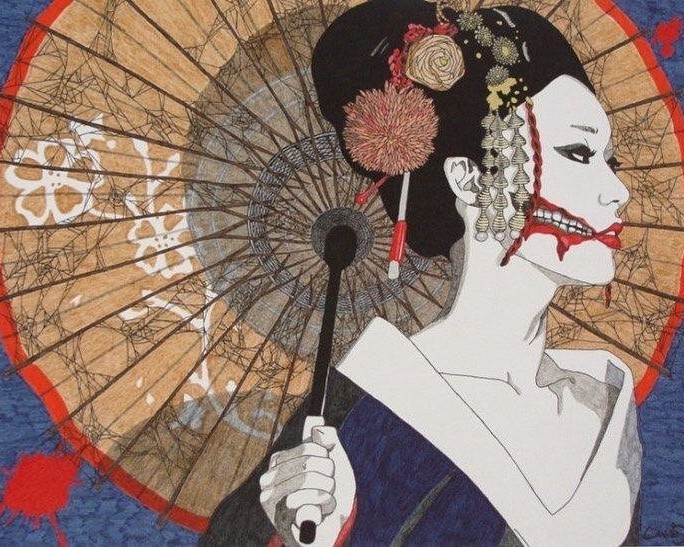
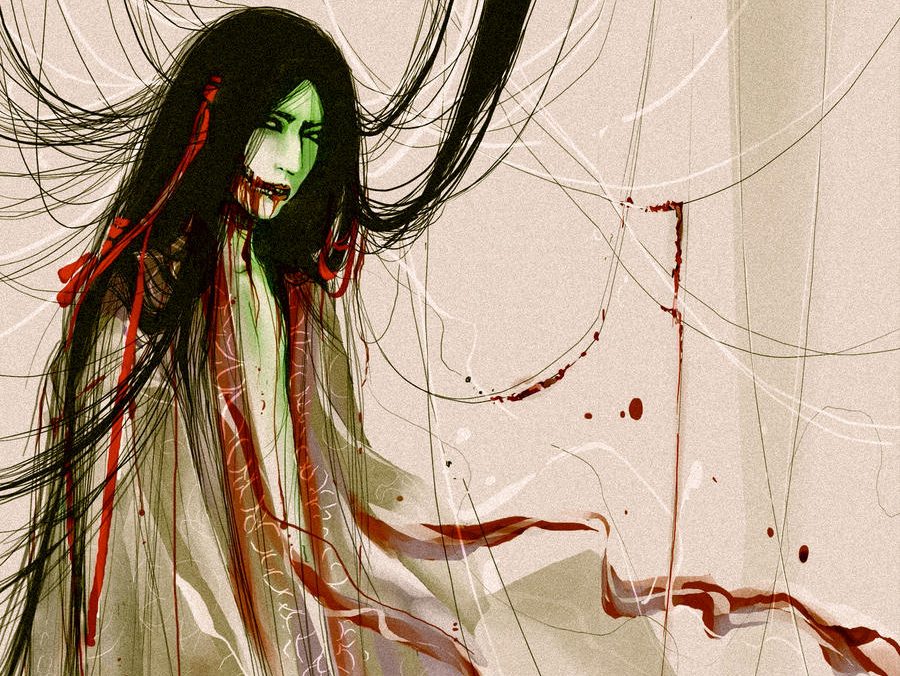
Tag: Kuchisake-Onna

  • Kuchisake-Onna, Feminist Monster?

    Kuchisake-Onna, Feminist Monster?

    Content Notes: Discussion of Child Murder, Misogyny and Mutilation

    In my previous two articles, we have discussed the origins and a myriad of possible interpretations for the tale of Kuchisake-Onna. However, the feminist themes of this mythical character have had more ink spilled than any other framework. So join me, as we uncover the femininity of Kuchisake-Onna and if her story can help you too.

    Objectifying Subjection

    We are all familiar with the idea of beauty being tied to goodness. It’s a form of Halo Effect, where a desirable attribute leads to us misjudging a person’s character or actions.[1] Essentially, since attractiveness leads to our initial impression of a person being favourable, this frames any future judgement in a complimentary light. However, when the Halo Effect meets femininity, there is an unusual cross section. Because attractiveness in women comes with benefits and equal drawbacks.

    In standard philosophy there is the object and the subject. The object is an entity which is perceived but cannot observe, and the subject is that which perceives others. When we talk of women being objectified, this is what is meant. A woman is, by most standards, a subject capable of perception and judgement. But within certain media portrayals she is relegated to an object, to an item for the (usually heterosexual male) characters and audience to perceive without having to consider her view.

    An object also lacks agency. They are incapable of enacting or interacting with the world in any meaningful way. To be objectified is not simply to be admired as if you were a crass statue, but also to be denied your ability to act. This can be as straightforward as a piece of media disregarding a woman’s desires in a story. Or as blatant as the authorial approval of the character being dominated or possessed by a man.

    Megan Fox in Transformers (2007), Produced by Paramount Pictures
    Retrieved From: IMDB

    Whilst this objectification can happen to any woman in media, it is most apparent with those deemed attractive. In books this creates the “Breasting Boobily” phenomenon, where the sexually attractive features of a woman are constantly highlighted, to the point of absurdity. In film and TV, this is accomplished by cameras lingering over the desirable parts of the character, focusing and framing their sexual attractiveness as their most important aspect. In art it results waist to hip ratios that would make insects blush. An attractive woman’s identity comprises only her physical form, that which the audience can instantly perceive, rather than any other characteristics or facets of personality.

    With Kuchisake-Onna, part of her horror comes from firstly conforming to these expectations and then subverting them. Her beauty creates a Halo Effect and places her as an object within her own story. She is considered to be harmless or even virtious by the target. In addition, she is usually admired solely for her beauty. Like a piece of street art, the narrative regards her as something to be lecherously enjoyed. Some stories even portray her as a sex worker, a group known explicitly to face dehumanising objectification.

    But with the revealing of her slit mouth, Kuchisake-Onna goes from an object of desire to a subject enacting sadism. The narrative switches, transforming her into the one who is perceiving her victim. She delights in her macabre questioning and the slaying or “improvement” of the object. But this not only changes her status in the story, but the entire perception of her character.

    Don’t Lie by Dark134
    Retrieved From: Deviantart

    The Halo Effect disappears as her true form is revealed and she becomes monstrous. I understand some people have…intense feelings about the slit mouth woman. But the most pervasive and intended narrative is one in which the carnal appetite of the victim and audience are rebuked. She becomes an active agent against the desires imposed upon her. And therefore becomes a horrifying subversion of narrative expectation.

    Unwomanly Virus

    Barbara Creed argues in the The Monstrous Feminine, that femininity is deemed as evil because although it is feebler than masculinity, it’s framed more carnal and without restraint. [2] She contrasts this with Julia Kristeva’s idea of “The Clean and Proper Body”. This is a symbolic body that all should strive to achieve, one of artifice, that exhibits no sign of natural degradation. Creed states this symbol is particularly difficult for feminine bodies to maintain, due to the trials of motherhood, puberty and loftier sexist standards. But if one can accomplish this task, you then become the pinnacle of artificial femininity, devoid of the usual degrading associations.

    Obviously Kuchisake-Onna’s body, particularly the slit mouth, automatically excludes her from such ideals. But it is within a method of wounding her victims that a more unusual connection can be revealed. When answering her questions with “yes” both times, most stories say she slices the person’s mouth with her scythe, granting them her trademark look. A direct interpretation would be ironic punishment. For saying she is pretty, in a morbid way, she makes you pretty too. You could extend this further saying that the punishment for appeasing vanity is to have your own beauty marred. To fawn and placate such ideals allows them to ruin you.

    Created by Jenna Whyte
    Retrieved From: Instagram

    But using the idea of The Clean and Proper Body, we can see Kuchisake-Onna as a defeminising monster. The threat of carving a person’s face is not just an attack on bodily integrity. For women, it is an assault on their Clean and Proper Body. The slashing of their face not only renders them as hideous as Kuchisake-Onna, but as defeminised as her. They lose a core part of their identity. Their gender. Or at least, the way they have been able to express their gender until now.

    When paired with the Halo Effect, to have your attractiveness and body scarred becomes a mark on the entirety of your life. Your goodness is lessened. Your social status tanks. Even your personality could drastically change due to how you’re treated in the aftermath. The threat of a slit mouth for women is a complex intertwining of societal and physical repercussions.

    But even more so, it shows the fragility of such concepts. Like glass, the idea of a Clean and Proper Body is pristine and beautiful. But also cracks under the slightest amount of pressure. A fundamental chip in such a body becomes a pox, an indelible sign of ruin that cannot be revoked. The horror for women is not solely in death. But in the idea that the sexist ideals they must take on to survive can be freely broken. It takes one accident, one problem, a isolated event going wrong and their body shatters. With one mistake they cannot control, they become Kuchisake-Onna.

    A Monstrous Femininenon

    In her essay, Monstrous Women, Dianne Taylor posits that women become monsters when they fail to be feminine.[3] Taylor relates this to the fact women are less likely to receive the death penalty in the USA, arguing it is not solely benevolent sexism. Instead, for any one woman to be considered for the death penalty she must be:

    “incorrigible, irredeemable because she is thoroughly immune to refeminization —a monster”

    In her eyes, immunity to re-feminisation is monstrous because of how it violates both biological and social laws. Using the works of Foucault, she states that key to the judicial power of modern governments is the idea that individuals can be corrected, usually through punitive measures. But to be corrected one must accept a norm to follow, an ideal standard of what it is to be good. For men and women this is different, but frequently relies on the reuptake of gendered norms. And especially for women, biological and personality based norms intermingle as if they are one.

    A woman is not separate in character to a man because of environmental factors, at least according to dominant social narratives. Instead, it is her [Insert Relevant Pseudoscientific Explanation]. Whether it is wandering womb, the curse of oestrogen or that pesky underdeveloped pre-frontal cortex, a sexist society will always find a way to justify women’s supposed inferiority. And if a woman is smarter, more athletic, more rational or otherwise supersedes men in masculinity? Then she is showing the fragility of such norms. In refusing to go back into the feminine domain, she is violating both biological and social truths that society is built upon. [3] And becomes a monster to society at large.

    A Clinical Lesson at the Salpêtrière (1887) by André Brouillet
    Retrieved From: Wikipedia

    In this way, we can identify how Kuchisake-Onna violates these cornerstones. Whilst undeniably irrational, she is always portrayed as outcompeting men in athleticism and sadism. In doing so, she establishes her dominance over men quite easily, capable of inflicting bodily harm in a way foreign to most of them. As well although not traditionally smart, her manipulative tactics demonstrate how she can outsmart men by undermining their expectations of logical answers. This contradicts ideals of rationality, causing a terrifying breakdown in the norms of conversation which may end up in an unfortunate demise.

    In addition part of the horror is in the lack of explanation for her violations. There can be comfort gained from developing an understanding of how a person would break away from norms. These explanations do not need to be true, instead they merely have to contain enough verisimilitude to placate the person’s fears. It is never explicit stated if Kuchisake-Onna is just a hysterical woman, a supernaturally powered ghost, a demon or anything else. By never having a apparent grounding of who or what she really is, a sense of safety in knowledge is impossible to reach. Therefore, the person is confronted with an unknowable dread for a humanoid monster they will be impotent to fully comprehend.

    Slicing The Glass Ceiling

    But we can get even more specific with Kuchisake-Onna’s breaking of normative ideals. Ryden Shartle provides an excellent summarisation of the history of feminism in Japan.[4] This additionally provides a detailed background for the specific sexist norms perpetuated in 20th century. The 1920s saw a frequent scientific rationalisation for women performing housework, domestic hygiene and other activities, for the betterment of the Japanese people. This selflessness as feminine virtue was expanded in the 30s, with women being corralled to volunteer in making care packages and performing nursing duties in the army.

    Next (hopefully shocking no-one) there was the US occupation. This saw a time period where women were provided more rights, in hopes of instilling fewer sexist values…Oh wait, sorry I got that wrong. It was in the hopes of limiting Japanese military power. Lovely. After the US left, the Japanese government focused on reversing this and encouraging feminine education. This sounds pleasant, but it was principally activities like home economics and flower arranging. The idea behind this is that by having separate spheres for men and women, Japan would catch up with the US. One can provide for the home, and the other can provide valuable work, therefore maximising efficiency.

    Before the 70s, a lot of Japanese feminism even exemplified sexual differences, focusing on women’s roles as mothers and caretakers to gain more rights.[4] But then came the Ūman Ribu movement, a transliteration of women’s lib. Combining international thought with Japanese feminism, the Ribu movement was the first time that women sought to challenge men’s cordoning of roles in a unified manner. This revolved around radical feminist challenges for what it meant to be a woman in Japanese society. As well as the role they could play both individually and within the society. Which is around the same time a certain folkloric monster began to rise to prominence.

    Kuchisake-Onna by Wolf-Ram
    Retrieved From: Deviantart

    As opposed to selfless virtuosity, Kuchisake-Onna seems entirely rooted in selfish sadism or malicious madness. It is never fully expounded on, but through various texts and writings, the common through-line seems to be that she is just a cruel monster. It is her nature, either through jealously, spite or misanthropy to injure others with no feminine motive. In fact, as commented on by Taylor, the act of sadistic murder is itself considered to be masculine.[3] To delight in harm, to enjoy the process and to come out the other end unforgiving, is counter to any ideals of feminine selflessness.

    As well her actions are complete opposite to the idea of a maternal figure. Not only in the evident sense of being a murderess but in being outside of the home, usually in metropolitan areas. Places where it is expected to predominantly witness men at or leaving work. Her mere presence in such a place is a disturbance of the isolated spheres for men and women. In the act of not only existing, but overpowering men within these spaces, she represents a complete reversal of the natural societal order. An uneasy contradiction by her very existence.

    This fear is exacerbated by the fact that the Ribu movement at the time was pioneering such changes. They urged women to occupy men’s spaces in radical ways that deliberately destabilised the sexist ideals that restrained them to the home. But to the men experiencing this destabilisation, considering their security was built on the labour and isolation of women, I’m convinced it looked contiguous to the myth of Kuchisake-Onna. An opinion reinforced by the fact that her tale was largely spread due to male owned women’s magazines sensationalising the story. [5] In a way, her tale can be seen as spreading due to the feared threat and irrelevancy of masculinity at the time. She, like the Ribu feminists, was an inoccent seeming woman attacking masculinity in the very sphere it was meant to propogate.

    Popularity Contests

    Through all of this discussion, you may have gotten the impression that Kuchisake-Onna can be an imperfect feminist icon. That her story of bucking feminine ideals, representing feminist movements and becoming her own subject is empowering. Well, I am not going to fully deny that interpretation. Part of my love of Kuchisake-Onna is because she represents a lot of what I enjoy in stories. She’s a monstrous woman, a biological freak of nature that weaponises her perceived deformities and femininity against the tropes that would imprison her. It is not without merit to recognize something significant and relatable in her tale.

    However, as pointed out by Dianne Taylor, such stories are frequently to the benefit of a sexist society. [3] The violation of norms does not sever them; it instead enables them. Through the monster, a person can justify previous prevailing norms, using the event or story as an argument against the removal of them. As much as I’d love the re-interpretation of Kuchisake-Onna to be more powerful, it is never going to outdo the most conventional narrative. Her tale was, in part, propagated by men and mass media as a way to castigate and shame women. In particular feminists.

    Therefore, even if we as individuals can see Kuchisake-Onna in this way, it would be challenging to reform how most media explores her. I have read through dozens of articles about Kuchisake-Onna, and the non-academic ones invariably portray her as a freak.[6][7][8][9] Even more so, these articles barely mention much of the alternative interpretations of her story. Instead distributing one version of the tale they deem to be the most horrifying and clickbaity. Because complexity is difficult to grapple with. It has taken me over a month to produce a bare minimum amount of research to provide some varying perspectives. And I like reading academic papers.

    Medusa Head by IrenHorrors
    Retrieved From: Deviantart

    This can be seen with other mythological characters as well. I’m certain those reading this will likely be familiar with a plethora of interpretations about Medusa. But, ask most people who aren’t history nerds (or sapphic), and the invariable response will be that she is a villain. An object for the projection of sexist tropes where she is to be slain by a man because she is a monster. Such stories are usually engrained in pop culture. Unless someone wishes to undertake the work to dig deeper, they will never get to the other sides of these narratives.

    But that is not to say we are without hope.

    A Case For Monsters

    Shartle recounts how the Ribu movement focused a lot of work on filicide. [4]At the time, Japan was facing an unprecedented reporting on women killing their children. These mothers were vilified and routinely lambasted as inhuman. But Ribu figures like Yonezu Tomoko argued that whilst filicide can never be condoned, one should blame societal conditions rather than the mothers. These women were often marginalised and desperate. Whether it be poverty, abuse, untreated mental health issues or any other variety of vulnerability. Society failed to care or aid them in any capacity. Therefore, instead of dehumanising, we should empathise.

    To shift the narrative that pits monstrous women as unfeminine, one should not exacerbate the contrast but soften it. By influencing people to empathise with the socially deemed worst of the worst, we can directly threaten and destabilise the sexist tropes that prop them up. Even personally I have seen the efficacy of this. In talking to mothers within my life, the discussion of maternal filicide has come up. And often promoting empathy with these filicidal actions not only helps promote understanding, but allows them to tackle internalised sexist ideals towards themselves. In inviting people to care for a “monster”, they are allowed to realise they too are not a monster.

    Unfortunately, folkloric tales like Kuchisake-Onna end up being too abstract for people to empathise with her. An individual cannot interview Kuchisake-Onna. You cannot witness her crying because of what happen. Nor can you ever follow her consistent growth and change. It is the strength and weakness of folkloric myths that they are shorter and often personalised tales. Weaved to the society, social groups and individuals interpretations of what the tale is.

    I truly believe there is power within stories, but to utilise it we must pick the tales people can relate with. In inciting individuals to examine the monsters society generates, a person can more clearly see themselves in the imposed stigmatisation. Moreover, you can follow the person’s own narrative. How they felt, understood and reckoned with their actions. In essence, you can humanise a monstrous human more than a folkloric figure. And doing so demonstrates that monsters are not real. They exist solely in stories but are transposed onto real life, to constitute a convenient scapegoat for societal ills. In making a case for “monsters”, we make a case for the liberation of all of us.

    Thank you for coming with me on this journey. I hope you enjoyed this mini series on Kuchisake-Onna. I will be back with some musings on one of my favourite poems in a fortnight. Until then, let me know your thoughts below!

    References

    1. Wikipedia Contributors. (2019, April 18). Halo effect. Retrieved from Wikipedia website: Wikipedia
    2. Creed, B. (1993). The Monstrous-Feminine: Film, Feminism, Psychoanalysis. London: Routledge
    3. Taylor, D. (2010). Monstrous women. PhaenEx, 5(2), 125-151.
    4. Shartle, R. (2023). Motherhood, Femininity, and the Body: Reading Representations of the Feminine in Kuchisake-onna (Postwar Japan) (Master’s thesis, Arizona State University).
    5. Michael Dylan Foster. (2009). Pandemonium and Parade. Univ of California Press..
    6. Dowell, C. (2024). The Legend of Kuchisake-onna: Japan’s Slit-Mouthed Woman. Retrieved from: Medium.com
    7. Unknown Author. (2024). The Legend of the Kuchisake-onna: The Slit-Mouthed Woman in Japanese Urban Legends. Retrieved from: Mythology Worldwide
    8. Harvey, A. (2023). Kuchisake Onna: The Vengeful Japanese Spirit That Attacks Victims After Asking “Am I Beautiful?” Retrieved from: All Thats Interesting
    9. Meyer, M. (2024). Kuchisake onna | Yokai.com. Retrieved from Yokai.com website: Yokai.com
  • The Many Faces of Kuchisake-Onna

    The Many Faces of Kuchisake-Onna

    Content Notes: Discussions of Ableism, Castration, Classism, Misogyny and Vagina Dentata

    In my previous article we examined the history of Kuchisake-Onna, exploring the many posited origins. But the interpretations of her are even more numerous. Academics and amateurs alike have understood and reimagined the slit mouth woman in a plethora of diverse ways. So, without further ado, let’s dive into the depths of Kuchisake-Onna

    What’s In A Smile?

    The most distinctive feature of Kuchisake-Onna is her slit mouth, described in various ways, from sheathe-like to…well “sheathe-like”. But, interestingly, I can find only one article comparing her most distinctive feature to real life facial disabilities. Kun Hwang authored a paper relating the mythological figure to lateral facial clefts, that is a congenital opening of the face around the mouth.[1] He wrote a passage that I believe is important to initiate this discussion of Kuchisake-Onna.

    “We plastic surgeons should be aware that facial cleft patients in past societies may have been treated as ‘Ghosts’ who harm other people.”

    Within any discussion of folkloric figures and the horror of disability, it is critical to recognise one fundamental truth. People will use these stories to otherise those with similar disabilities, to treat them as monsters. As much as we can abstract the various parts and tales of Kuchisake-Onna to look at societal issues (and trust me we will) it’s equally important to recognise the more obvious reflections. How a society, even a modern day one, treats and perceives those with disabilities.

    Clefts, scars and other physical differences can cause medical problem for the individual. However, when stories villainise and stereotypically portray them, it is not for the fact they are detrimental to the person with them. Indeed, Kuchisake-Onna’s slit mouth is not disgusting for the effects it has on her but the effect it has on the viewer. This centring of the (presumed) physically normative individuals reaction is exceedingly common in all media representation of those who experience visible disabilities. But in all of horror’s subgenres, including folklore, it is strikingly apparent. The removal of limbs or deforming of the body remains a staple of the genre as a way to get a quick and easy shock. The sensationalism of this is a lesson to the audience. That those who possess similar features should be viewed as inherently horrific and unusual. Whether this means they are pitiable or villainous depends on the tale.

    Kuchisake Onna By Jessica Lauser
    Retrieved From: Facebook

    But there is another layer of this to unpack. Kuchisake-Onna disfigurement is repeatedly described as having come about due to a surgical procedure, either a vanity based plastic surgery[2] or as a result of trying to be rid of a pre-existing cleft.[1] The first case plays into two tired but tested tropes of fiction, the vain woman getting ironic revenge and the use of disability as retribution. The former will be discussed in another post, but the latter is worth investigating further. Disabilities are not solely used as a sign of a deformity in character but as some form of karmic or divine justice for a person’s misdeeds. This reflects on the disabled individual as inherently corrupted, perhaps even from birth. Their disability, therefore, can be seen as a shorthand for the stain upon their soul that the audience can instantly identify. A lesson which is then replicated in real life.

    The second case represents a notable contrast to the first, as the implication (in my opinion at least) is that in trying to reduce her cleft, she is punished. One could interpret this as again punishing vanity, but I think there is another interpretation. That those with disabilities cannot win. That by trying to change your physical difference, you are transgressing. Because if a person can change themselves to look like the physical majority, it shows the artificality of such a construct. If it is not inherent, but something which can be achieved through sleight of hand, it loses both it’s power and meaning to those born physically normative. This idea, is unpalatable to many, so stories and folklore exist to counter such narratives.

    It is somewhat ironic for a famous myth that villanises those with facial clefts to quite accurately surmise the catch-22 many find themselves in. There is no winning for the physically different but to atone in the manner society seems fit. Which is typically whatever soothes the mind of the physical majority and encourages them to feel better, at the cost of the physically different.

    Sheathing A Theory

    Let’s take a breather from the somewhat depressing societal implications and talk about something much more fun. The psychoanalytical theory relating to Kuchisake-Onna. For those who don’t have an extra psychology degree lying around (and why don’t you?) psychoanalytics is the field of psychology pertaining the ideas of Sigmund Freud. You may have heard of Freud through the Oedipus complex, the idea that adolescent boys really… REALLY love their mothers. But the topic relevant today is castration anxiety.

    Castration anxiety is pretty much what it sounds like, the belief that pre-pubescent boys are pathologically scared of being castrated.[7] This comes about because apparently boys believe their mothers are castrated men, rather than women. Freud really did just get away with declaring anything. As reported by Barbara Creed in her seminal work The Monstrous-Feminine, Joseph Campbell first linked castration anxiety to vagina dentata.[8] That is, a literally toothy genital, a la Teeth (2007). The vagina dentata appears in a variety of cultures and according to Campbell is a sign of men’s latent castration anxiety and fear of vaginas. In addition Campbell argues it represents gynephobia, a term used by Freud to describe men’s fear of women’s sexuality and feminity. This is often considered decoupled from misogyny by psychodynamic academics. How much you wish to decouple it is up to you.

    Photograph of The Livraria Lello & Irmão
    By uninformedcomment
    Retrieved From:
    WordPress

    At this moment, you may be rather reasonably asking, how does a slit mouthed woman relate to a toothed genital? Well the idea of vagina dentata, and a lot of psychodynamic symbolism, is its focus on evoking iconography. Even if they’re not necessarily the exact same symbol. In this case, both Foster and Shartle make comparisons to Kuchisake-Onna mouth and female genitalia.[2][4] The essential point is Kuchisake-Onna is part of a lineage of vagina dentata stories. And Kuchisake-Onna’s rise to fame is a representation of the prevalent fears Japanese men had in the 70s. This fear was presumably aided by the rise in feminist movements at the time. And the theorising is not merely academic. I wish I was kidding, but Foster found the following anonymous quote from a male student:

    “The mouth of Kuchi-sake-onna is genital-like. And what’s more, it’s ridiculously huge and gaudy and unclean, so I don’t want to be touched by it!”[2]

    I mean at least he was honest.

    You may have noticed throughout this section my incredibly subtle disdain. Some of it is around 5 years of repeatedly having to listen to Freud’s weird personal theories that feel like textbook projection. But, as well, nearly all of psychodynamic theory has fallen out of vogue in psychology because people just don’t often think this way. You will be able find some cases of people who are…let’s say highly sexed. But the unconscious framework underlying seeing a slit mouth as a sexual object both cannot be proven and is not the simplest explaination.

    Castration anxiety could just be the relatively ordinary feeling the majority of people have about their most sensitive area being hurt. Made worse for the half of the population for whom that area is exposed.As for vagina dentata, it is theorised to originate from medical stories of calcified lumps within vaginas.[9] And unlike nearly all vagina dentata myths, Kuchisake-Onna does not emasculate her victims, let alone with her teeth. She slices people with scythes or scissors which is either a left over from her rural predeceeding folklore or just a common household item.

    I do believe there is some merit to the idea that Kuchisake-Onna represents the fears of men. However, there is a tendency in psychology and especially psychodynamic theories, to over-generalise and overcomplicate simple ideas. The fear of being harmed and the misogynistic framing is more likely to be context and socially specific, rather than tapping into a disproven latent fear.

    A Class Act

    As stated in my previous post, Kuchisake-Onna first spread around Japan through the juku or preparatory schools, which were new at the time.[3][5] In fact, Takaji even believed that the rumour spread as a method of keeping lower class children out of these schools.[3] By instilling fear of being in the city at night, it could convince children to never attend. This in and of itself, its emblematic of the class divide within Japanese society. How many disliked or outright feared the intermingling of numerous sects that used to be separated. There was a palpable anxiety around the blurring of distinct strata and what that would mean for those who benefitted from such a system.

    However, one cannot separate Kuchisake-Onna from her rural beginnings. From her tale originating in the Gifu Prefecture and likely being inspired by ghost stories of the farmer’s uprising in 1754.[10] To her oft used scythe, an item rarely seen in urban settings and considered short hand for rurality.[2] To even the methods of repelling her evoking traditional Edo period yōkai, such as chanting “pomade” three times. [2] Kuchisake-Onna is part and parcel a tale of rurality within an urban setting and the mismatch between those two worlds. And with that mismatch, comes classism.

    Japanese Tales by loputyn
    Retrieved From Instagram

    In the 1970s, on top of a wave of feminist thinking, the Japanese population was beginning to be disillusioned with urbanisation. This was somewhat due to a lack of worker’s rights as well as an increased separation between the urban and rural. [2] Accompanying this was an almost fetishistic level of adoration for the past including for previous mythology of that time. This led, in some part, to the adoption of Kuchisake-Onna. Foster claims that she can even be seen as a trasitional folkloric figure, incorporating both the old and the new. In this way, she represents the desire of many to return to simpler times. But the view was rather rose tinted, as alongside this rise in traditionalism, was an elevation in disdain for the working class.

    The 1970s saw a rise of worker’s strikes and student protest within Japan.[2] Many stories of the strikers at the time were exaggerated, frequently portraying them as boorish and even violent. The mask Kuchisake-Onna is reported to wear can be seen as a sign of protest, as it was used by many political movements to provide anonymity when protesting. As such, the story aligns Kuchisake-Onna with the perceived violent protests, demonstrating the danger that may lie under the mask. This can be extended further to a more impersonal interpretation. The fear of the wealthy about what student and worker’s rights protests may mean for sense of safety and security. Both in a financial and very literal physical way.

    As a result, Kuchisake-Onna can be viewed in two contrasting ways. Both as a call to the good old times of strange folklore from rural areas and as a sign of the violence from seemingly kind working-class people. eve the former isn’t exactly a much more favourable interpretation. It leans on tropes that patronise rural communities, depicting them as strange, backwards people with their unusual customs. In essence, mystifying and dehumanising those in rural communities, contrasting them with the more “civilised”, advanced urbanites.

    In either case, Kuchisake-Onna could be understood a folkloric backlash to the widespread changes that were happening, and the security of the wealthy being threatened. However, this would not fully explain Kuchisake-Onna wide adoption by the rural and working class. So I have one more aspect to share today.

    The Horror of Cities

    The urban environments where Kuchisake-Onna propagated were new to many children and adults. As many a horror media can attest, there is a liminality and dread of such environments when devoid of people. Liminal spaces, in internet parlance, represent the quietly unsettling transitional margins.[11] Often this can be witnessed in pure white corridors within a hospital, a clearly utilitarian artifice that feels devoid of emotions. These hallways exist purely to transition you between different rooms. There is something disquietening about the lack of warmth or humanity in such places. The emptiness in these spaces adds to the unease, as we naturally feel that such spaces should be filled with people and objects. One can view the walkways of urban settings as liminal areas, as they exist merely to transition us between buildings.

    A Hobbytown Under Renovation by Bill Magritz
    Retrieved From: Wikipedia

    If you’ve ever walked alone in a city at night you’ve most likely experienced the horror of liminality. Shadows become people, wind becomes footsteps and buildings become toppling towers. It’s not impossible to identify how people’s fear of this unnerving environment was entangled with Kuchisake-Onna. How transposed onto an originally rural myth, spread a fear of an attractive stranger who was out to wound you in this strange urban hellscape. Who you could never truly tell the intentions of what lied behind the mask. A figure who left you wondering if she was as devoid of humanity as her surroundings.

    Additionally, when Kuchisake-Onna rose to international notoriety there was an increase in awareness about the health impacts of city environments within Japan.[2] People were realising the mental, physical and financial toll the move towards city landscapes as the new hotbed of industry was having. Of particular note was the uptick in cadmium and mercury poisoning as well as the increasing risk of smog. This led to a rise in people wearing masks, as a preventative measure against an environment trying to defeat them.

    Therefore, as Foster argues, one can see Kuchisake-Onna as a representation of these fears.[2] Her mask and the revealing of her disfigurement underlies the concerns of the people living in these contemporary and hazardous environments. How they fear the fact that they too, may become physically ill or even disabled, because the city itself is killing them. Though her slit face mimics a genetic disability, it can be seen as representation for all kinds of illness. As well, her rural trappings can be seen as a contrast between the two environments. How, when the rural transition to the urban, the sole result is a harm to yourself and to those around you.

    With all this said, I am eager to hear your thoughts and interpretations of Kuchisake-Onna. There will be a final essay about the many feminist links to Kuchisake-Onna in two weeks. I hope you’ve enjoyed this. Until next time!

    References

    1. Hwang, K. (2023). Slit-mouthed woman (Kuchisake Onna) and plastic surgery. Journal of Craniofacial Surgery, 34(5), 1370.
    2. Michael Dylan Foster. (2009). Pandemonium and Parade. Univ of California Press.
    3. Asakura, T. (1989). Ano kuchisakeon’na no sumika o Gifu sanchū ni mita’“uwasa no hon” Takarajimasha
    4. Shartle, R. (2023). Motherhood, Femininity, and the Body: Reading Representations of the Feminine in Kuchisake-onna (Postwar Japan) (Master’s thesis, Arizona State University).
    5. Yoshiyuki, I. (2019). Japanese Urban Legends from the “Slit-Mouthed Woman” to “Kisaragi Station.” Retrieved From: Nippon.com
    6. Hayakawa, K. (2008) Kowai hanashi – anata no shiranai Nippon no “kyōfu”, Mirion Shuppan
    7. Freud, S. (1927), “Fetishism’,The Standard Edition of the Complete Psychological Works of Sigmund Freud, 24v ols, trans. James Strachey.
    8. Creed, B. (1993). The Monstrous-Feminine: Film, Feminism, Psychoanalysis. London: Routledge
    9. Wikipedia Contributors. (2025). Vagina dentata. Retrieved from Wikipedia website: Wikipedia
    10. Hayakawa, K. (2008) Kowai hanashi – anata no shiranai Nippon no “kyōfu”, Mirion Shuppan
    11. Wikipedia Contributors. (2025). Liminal space (aesthetic). Retrieved from Wikipedia website: Wikipedia
  • The Origin of Kuchisake-Onna

    The Origin of Kuchisake-Onna

    If, like me, you watch far more anime than is healthy you are likely familiar with Kuchisake-Onna. Directly translated into English as the Slit-Mouthed Woman, she is a beautiful being who at first looks human, but soon reveals her true ugliness. I, like many, believed that this story came from far back in the annals of Japanese history. However the origins of Kuchisake-Onna, are not so cleanly sliced

    Understanding the Story

    The story of Kuchisake-Onna has some variations depending on the version, but all follow the same fundamental idea. A woman was killed by having her mouth slit, usually because she cheated on her spouse or had plastic surgery. However, death proves to not be the end, as she rises once more as a vengeful spirit. In this form, her slit mouth is concealed by something be it a fan, handkerchief or surgical mask. In addition, she now wields a sharp object, usually a scythe but it can be a knife or even scissors. As part of her vengeance she seeks isolated people, usually men or boys, on dark nights and asks them a simple question.

    “Am I pretty?”

    Most people would reply yes, but those who decide to respond negatively are swiftly slain. But should you be affirmative, a second question is asked, punctuated by the revealing of her disfigurement.

    “How about now?”

    If you say no, she will slice you with her scythe. If you say yes, she will make your face as pretty as hers. Rather horrific right? There are ways to be spared, though it changes with every telling. Some say that pomade, or hair wax, can ward her away. This is to the point just chanting pomade three times can get rid of her. Others mention throwing candy or offering it to her will satisfy her bloodlust. There’s even versions that suggest you simply answer yes twice, although I would not personally risk it.

    Image Credit to Benjamin Mako Hill,
    Retrieved from:Wikipedia

    Pinning Down An Origin

    When first researching this, you will come across a variety of webpages attributing the tale of Kuchisake-Onna to the Edo period, that is from around 1600 to 1853. [1][2]. In fact one article even reported that it existed in the Heian period, around 784 to 1185. [3]. However when reading these accounts, you will notice something quite plainly. There is literally no academic evidence given to support such a conclusion.

    So next, you would turn to the bastion of academic integrity itself. Wikipedia. The site lists two possible origin points, the Edo period and the late 20th century [4] The former hypothesis is referenced with two pieces of data. An image from the 1801 book Ehon Sayo Shigure by Hayami Shungyōsai and a blog post on Kuchisake-Onna by folklore illustrator Matthew Meyer:

    From Ehon Sayo Shigure by Hayami Shungyōsai,
    Retrieved From: Wikipedia

    “During the Edo period, a large number of Kuchisake-Onna attacks were blamed on shape-changed kitsune playing pranks on young men.” [5]

    Ehon Sayo Shigure is nearly impossible to obtain, but there is some second hand reporting I will touch on later. However Meyer, never actually references any account to back up his claim, so we can somewhat discount it. Though I do have an idea that could explain it. But to do so I need to take you to the beginning of Kuchisake-Onna. To a grander, more innocent time long forgotten by all but the oldest soul. An ancient period of humanity shrouded in mystery.

    1978.

    The Elderly Modern

    As reported separately by folklorists Iikura Yoshiyuki [6] and Michael Foster [7], the first textual reference to the tale of Kuchisake-Onna was in December 1978. Specifically, it was the story of an elderly woman, living in a rural area of the Gifu prefecture. At night, she saw a slit-mouthed lady standing in the corner of her garden, who disappeared without a trace. Yoshiyuki goes on to speculate that the propagation of the myth started with children in the prefecture who intermingled in the new juku or preparatory classes. This led to a cross section of class and geography that had never existed, allowing such a captivating myth to mutate and spread. Journalist Asakura Takaji argues it may have been used to scare lower income kids from even attending these jukus[8].

    On top of this, Foster argues the tale captivated the minds of adults, with women orientated magazines at the time being absolutely crucial in relaying it to a maturer audience. The reach of Kuchisake-Onna was so rapid that by May 1979, it was in national news and there are records of her story within every prefecture. And this is pre-internet times, that is an astounding level of expansion and adoption for a folkloric tale.

    But if we are to believe that Kuchisake-Onna originates within this period, we would need an explanation for why it is tied to the Edo period. Foster argues that folklorists like Noboru [9] and Shigeru [10] tied Kuchisake-Onna to previous mythological women. This was not to just suggest a simple link in how stories often have archetypes and repeating narratives but instead as Foster puts it:

    “ ..based on a genealogical line of demonic women or some essentialist female nature…”

    In other words Kuchisake-Onna is treated as a inextricably tied to Edo period yōkai, in that she is the continuation of these stories. This leads to a muddying of her origin. Instead of being clearly created in the 70s, she is treated as a figure in mythology who has eternally existed. The latest story is relegated to a mere modern retelling. This becomes even more apparent when Shigeru ties Kuchisake-Onna to Iso-Onna, a tale of siren like women, by drawing the Iso-Onna with a slit mouth in his books. This attempts to recreate Kuchisake-Onna as a Edo myth, a titan of folklore. All of this, serves to confuse and muddy the water, leading to articles assuming that Kuchisake-Onna is directly from in the Edo Period. Or even that it can be confused with kitsunes.

    From Zoku yōkai jiten (Tōkyōdō Shuppan), 1984 by Mizuki Shigeru

    Though this is convincing, I don’t believe it to be the whole story. Whilst it is true that Noboru and Shigeru connections are shaky at best. There are real connections to Edo period mythology, which albeit not named Kuchisake-Onna, at least helped greatly to inspire the modern myth.

    Painting A Clearer Picture

    I previously mentioned an artwork by Shungyōsai from his book Ehon Sayo Shigure. Ehon is essentially a term for the type of publication, relatively similar to a picture book where art occupies most pages accompanied by text. The text alongside this drawing is part of a story. It describes a man who goes to procure adult services, and discovers a woman within the local hotspot [10]. The woman seems gorgeous although he can only see her back.

    However when she turns, a slitted smile is revealed, that goes from ear to ear. This causes the man to faint and the woman is never seen again. A similar tale exists in Hirachika’s story from the mid 1700s, although in this version, a man dies from shock.[11] These appear to be the first textual references to a slit mouthed woman in Japanese mythology, though they do not share the name of Kuchisake-Onna. Whilst the distinctive smile is certainly similar, the narrative around it feels far removed, apart from the surprise reveal. But these are not the sole examples of possible precursors.

    The next story comes from the Gifu prefecture. A woman tries to cross a mountain pass to visit her lover.[12] However, to stave off the danger of ne’er-do-wells, she bears a sickle and holds a crescent shaped carrot over her mouth. On it’s own this shares some vague similarities. But let me include some historical context. In 1754 the Gifu Prefecture, then the Mino Province, was the site of a farmer’s revolt known as the Gujo Uprising. [12] As you can imagine the event was a bloody affair, that prompted tales of vengeful spirits of the farmers who had been slain. It is possible the imagery of two local myths could have ended up intermingling. The spirit of a vengeful woman carrying a sickle, fawning for love and possessing an unusual facial feature. All of this helping invent the story of Kuchisake-Onna.

    Further more, some of the ways to deal with Kuchisake-Onna harken back to previous mythology. Pomade contains mugwort, a plant used as a ward against malevolent spirits. The chanting of pomade three times evokes the rituals of Shintoism. Even the candy trick was formerly used in stories of Ubume, the spirits of pregnant women who (in one version) wished to get sweets for their unborn children.

    Overall, a lot of Kuchisake-Onna’s tale appears to be piecemeal inspired by a variety of folklore that came before it. So whilst Kuchisake-Onna, as we now recognize her, definitely started in the 1970s. The story undeniably drew heavily from folklore of the time, as well as the events of the local culture.

    A Slice of Truth

    From all this inevitably follows the question. Why? Why would academics focus on ephemeral connections to kitsune and Iso-Onna, when real connections to actual Edo period mythology exist? In a word.

    Prestige.

    Foster mentions how Shigeru in particular fosters comparisons between himself and the legendary Edo period illustrator of folklore Toriyama Sekien. Sekien’s drawings of bizarre figures are some of the most well-known both within and outside of Japan. It is unfortunately common within all forms of academia that people are rather one track minded, making connections based on pre conceived notions of the research they are conducting.

    If scholars like Shigeru focus on the prestigious folklorists of the period, then it will be easy to miss the more humble connections. And the opposite occurs too. When academics decide to counter investigate the claims, they focus on completely discrediting the idea. Because a more nuanced “yes but no” is simply less interesting to their fellows and popular media.

    From Gazu Hyakki Yagyō by Toriyama Sekien

    I, myself, am not immune to this. In writing this essay, I started with the notion that I was going to be about how academics falsely created a connection to folkloric figures. That I was untangling a web of bias against urban legends in favour of more widespread classical myths. Though I believe it is a factor, it’s undeniable that there are genuine historical connections that were missed by Foster and Yoshiyuki. By trying and break down hypotheses lacking evidence, I almost overlooked a rich cavalcade of local and national history. All in the hopes of an exciting essay that devoid of any nuance.

    Because in all honesty, the real-life conclusion is a little boring. Of course an urban legend takes inspiration from previous myths and actual events. And whilst the details are fascinating to me. It’s a lot less salacious than academics deliberately lying due to bias or talking about how traditionalism obscures the beauty of modern tales.

    Even so, ultimately the truth of Kuchisake-Onna’s origin really does matter. The preceding stories that inspired her, as well as the unique historical context at which it arose, all inform how we can understand and interpret the tale. Without this knowledge, any analysis will be unable to articulate what captured the imagination of the people, and what ushered it as a viral hit before the internet existed. But that is a story for another time.

    I hope you enjoyed this essay on the origins of Kuchisake-Onna. I look forward to discussing the many ways she can be elucidated. Until next time!

    References

    1. Dowell, C. (2024). The Legend of Kuchisake-onna: Japan’s Slit-Mouthed Woman. Retrieved from: Medium.com
    2. Unknown Author. (2024). The Legend of the Kuchisake-onna: The Slit-Mouthed Woman in Japanese Urban Legends. Retrieved from: Mythology Worldwide
    3. Harvey, A. (2023). Kuchisake Onna: The Vengeful Japanese Spirit That Attacks Victims After Asking “Am I Beautiful?” Retrieved from: All Thats Interesting
    4. Wikipedia Contributors. (2019). Kuchisake-onna. Retrieved from: Wikipedia
    5. Meyer, M. (2024). Kuchisake onna | Yokai.com. Retrieved from Yokai.com website: Yokai.com
    6. Yoshiyuki, I. (2019). Japanese Urban Legends from the “Slit-Mouthed Woman” to “Kisaragi Station.” Retrieved From: Nippon.com
    7. Michael Dylan Foster. (2009). Pandemonium and Parade. Univ of California Press.
    8. Asakura, T. (1989). Ano kuchisakeon’na no sumika o Gifu sanchū ni mita’“uwasa no hon” Takarajimasha
    9. Noboru, M. (1985), Yōkai no minzokugaku: Nihon no mienai kukan(Iwanami shoten), 22–27.
    10. Shigeru, M. (1984). Zoku yōkai jiten (Tōkyōdō Shuppan).
    11. Kondo, M. (2002) “Hyakki Ryoran: Edo Kaidan and Y . (2002) Hyakki Ryoran: Edo Kaidan and Yokai Ehon Shusei” , Kokusho Kankokai; Hayami, S. “Ehon Sayo Shigure”; (originally published in 1801)
    12. Shibata, S. (2008) ed., Dictionary of Strange Stories and Irregular Stories; Hirachika, T. , “Kaidan Oro no Cane” (originally published in the Horeki Period)
    13. Hayakawa, K. (2008) Kowai hanashi – anata no shiranai Nippon no “kyōfu”, Mirion Shuppan