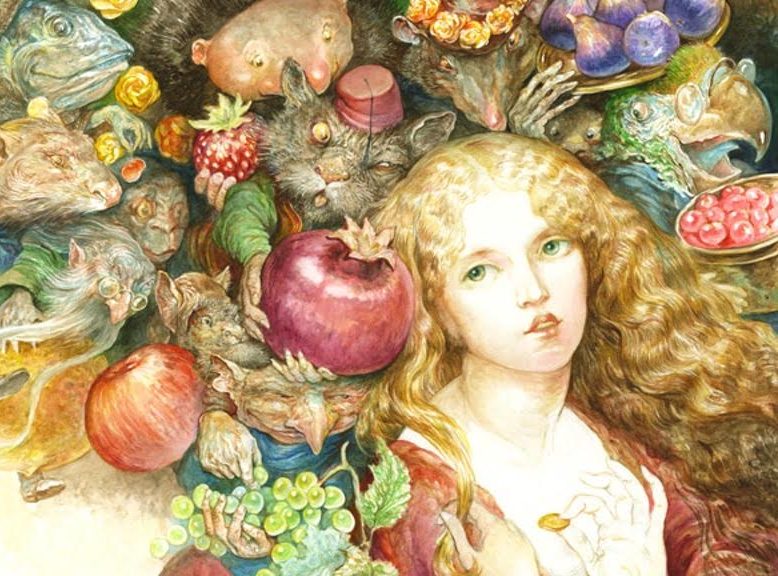
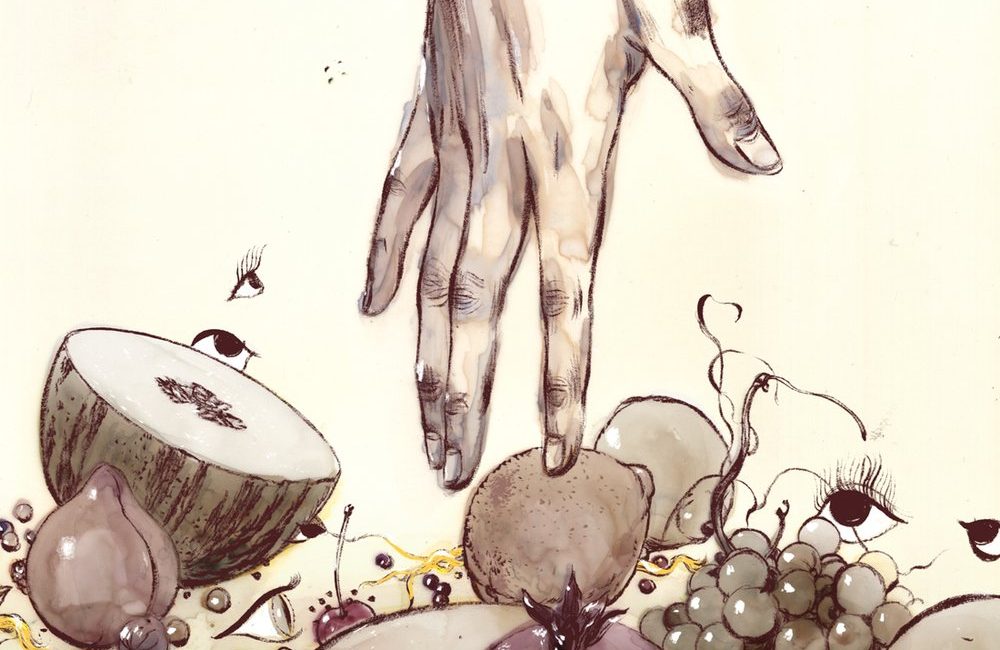
Tag: Poetry

  • Feasting on The Goblin Juices

    Feasting on The Goblin Juices

    Content Notes: Discussions of Anorexia, Child Death, Compulsory Heterosexuality, Corrective Rape, Incest, Orthorexia, Starvation and Sexual Predation

    We have previously covered both the historical context behind Goblin Market and the religious interpretations bursting from its prose. But now we turn to a more universal experience. Hunger. Hunger for food, for others and for love. As well as the hunger to rebuke our desires.

    Divine Sapphic Triads

    In her essay, Mona Reed argues that historical sapphic literature should not be confined to obvious erotic acts.[1] Paralleling Adrienne Rich, she supports the examination of disguised love, such as shared feminine joy, sisterhood and intimate friendship.[2] In this case, we can consider the relationship between Laura and Lizzie as not just one of biological sisterhood, but as a sapphic joining of the two girls.

    Using this foundation, Reed states that the Goblin Market itself purveys the destruction of women through the coercive nature of compulsory heterosexuality.[1] Compulsory heterosexuality (hereafter referred to as comphet), is a sociological phenomenon first posited by Rich.[2] She asserts that all children are brought up to believe that straightness is not only the default, but an essential requirement. Put differently, society is built around the sublimation of any experiences outside of the dominant straight lens. Like young girls can be lured by the promises of delicious fruit, so too are children disciplined into the delights of a purely heterosexual lifestyle.

    But just as the fruit leaves dear Laura destitute, so too does heterosexual dominance rely on the destitution of women. In a strictly straight (and albeit Western) paradigm, the agency, power and control are consistently given to the man, whereas the woman is expected to submit to their authority. Now, this isn’t true of every heterosexual relationship, trust me I live in the North East. More precisely, it is the societal standard by which other relationships are measured. Especially within Victorian England.

    Stained glass depiction of a crowned female figure holding a book and a flower, symbolizing purity and wisdom.
    Stain Glass Image of Saint Æthelthryth , Photographed by Fr. Lawrence Lew
    Retrieved From: Flickr

    This idea is supported historically as Christina Rossetti never married, and in fact, denied three suitors. [3] Although it should be stated, the first was denied because he converted to Roman Catholicism. Moreover, Christina Rossetti admired Saint Æthelthryth for her ability to maintain her virginity despite being married twice.[2] In rebuking the standard to bear children and accept intimate relations, she challenged the heteronormative dynamics of the time. In a similar vein, one can view Lizzie and Laura’s castigation of the Goblin Market as their rebuking of heterosexual ideals, although taken a step further.

    Whilst it might not be a full on celebration of sexual sapphicness, Reed presents a compelling alternative to a standard dyadic pairing of the girls. She states that:

    “Rossetti [suggests] that women should form queer, homo-social triad unions with Christ so they can abandon the institution of heterosexual marriage that leaves women feeling unfulfilled and emotionally depleted.”[1]

    The reason we can view this as queer is twofold. Firstly any undermining of the traditional heterosexual dynamic, especially that which involves same gender relations, allows itself to be viewed as inherently queer. For they are considered outside the norms of the society. But, even more so, Reed argues that Christ (and to some extent Lizzie) can be viewed as gender subversive. According to Reed, Rossetti regarded God as neither male nor female, instead containing an essence of both and yet beyond our conceptualisations of gender.[1]

    Additionally, she put forward that if one accepts Laura as Eve, then one must view Lizzie as Adam. She too is tempted and tested to see if her heart waives from God, through the fruit of the Goblin Market.[1] However, Lizzie never strays, and she takes on the pain of her Eve-like figure. In this way, Lizzie can seen as a bigender figure, taking on both aspects of male and female whilst never renouncing either. A deliberate countering of bimodal sex based ideals. Through this, we could see Rossetti as glorifying a homosocial order devoid of masculine interference. A place where women can take on the roles of both binary genders, whilst communing with God in a vaster capacity than ever before.

    I genuinely enjoy this interpretation presented by Reed, but we should ground it slightly. Whilst I believe that authorial intent should never be considered the official version of analysis. It is critical to state that this framing was likely not Rossetti’s intention and, at best, she intended a more religiously orientated view of sisterhood. Although Reed’s viewpoint is equally valid, we should not allow it warp our view of Rossetti. She was unequivocally a racist, classist and anti-Semitic poet, views which do not support the interpretation of her as a lesbian ally. Any reading of Goblin Market as sapphic happens in spite of, not because of, her own beliefs.

    The Sanguine Made Sweet

    As stated in my first Goblin Market post, Christina Rossetti had deep ties to the gothic literature movement. As researched by David Morrill, her uncle John Polidori wrote The Vampyre, one of the oldest works of Western vampire literature.[4] Additionally, her grandfather was a noted admirer of the gothic romantics, and Rossetti invested much time in her antecedent’s library. Her environment being inundated with gothic horror seems to have bled into Goblin Market too.

    On a purely aesthetic level, there are many similarities to gothic vampire novels of the time. Fair maidens tempted by the allure of unusual animalistic men, delighting in their own logic to ensnare victims in a way that drains the body until it wastes away. Additionally there is the focus on biting, sucking and consuming as the cause of the wasting away. Although Goblin Market arguably uses proxy vampirism through the fruits. Even the trickling of juices seems like a stand in for a more sanguine liquid.

    An illustrated portrayal of a ruggedly handsome man with curly hair and a determined expression, dressed in historical clothing, against a warm, textured background.
    Cover for The Vampyre by David Rabitte
    Retrieved From: Black Coat Press

    But in the details, Morrill argues there are clear comparisons to Polidori’s The Vampyre. Firstly, in how the vampire Lord Ruthven entices his victims. It is not merely in his honey words and rakish demeanour, but importantly in his charitable acts which always led to those cursed by it to sink into misery.[4] Put simpler, in giving to others Lord Ruthven ensured that they would become vulnerable, so he can feast upon them. Similarly, the charity of Rossetti’s goblins results in the downfall of Laura. By offering her fruits for the simple prize of a lock of hair, they make certain their corruption spreads and that they are able feed on her youth.

    The offering of her lock of hair also mirrors another vampiric tradition in Morrill’s view. Just as Lord Ruthven has to be invited into an abode, so too must the goblins be invited into Laura’s body.[4] Morrill explicitly links this to religious themes, that the vampire represents the devil, that evil incarnate cannot enter a person’s soul unless they consent to it. The consent can be achieved through trickery or deceit, but irregardless, the power rests inside the individual to rebuke or court evil within their heart. Even more so, the goblins never seem capable of leaving the glen to enter the girls’ house, as if they are barred from the Edenic gardens. And therefore can only feast on the innocent good when invited to.

    Building on this, both Lord Ruthven and the goblins can be seen as stand ins for the men who would prey on young women. Lord Ruthven rather by design is a debonair predator that feasts on the youthful vitality of women until they are nothing more than monstrous husks which cannot be saved.[4] The goblin men similarly prey on young girls, causing Laura to also waste away into virtual nothingness. Laura even wakes up on the night after the market, desperately gnashing and gnawing, like she has been molded into a vampire and is desperate to feed. It is like she has become the goblins themselves and has been reduced to animalistic hunger.

    Whilst I would not go so far as to state that Goblin Market comprises a form of vampire literature, I would say there are clear inspirations drawn upon. Some of this could be similar cultural touchstones, after all Polidori and Rossetti were devout Anglicans and it is not unlikely both would comment on the nature of evil. But others such as the enticement through charity and predation seem to be at least indirectly inspired. However, Morrill’s comparison does seem to miss certain conventions of vampirism, like it being contagious. Though he is not the sole researcher to establish these connections.

    The Sanguine Made Sapphic

    Rebecca Little combines themes from the previous sections to attest that Goblin Market is an example of homoerotic vampirism, in a similar vein (pause for silent chuckles) to Sheridan Le Fanu’s Carmilla.[5] Carmilla is a tale of the titular vampire, and her unrepentant hunger for Laura, the fair maiden. At 18, she meets Carmilla and is exposed to a world of sensual temptations and delights. However, in one of the first cases of “Bury Your Gays”, the vampire is executed for her depraved sapphic nature. And Laura is returned to Christian heterosexuality.

    Conversely in Goblin Market, it is our Laura who performs the role of vampiress. In the scene where Laura eats the goblins fruits, Little points to this section as key to her vampirism:

    “Suck’d their fruit globes fair or red:

    Sweeter than honey from the rock,

    Stronger than man-rejoicing wine,

    Clearer than water flow’d that juice;”[6]

    Here we can discern how the fruit starts as honey sweeter from the rock, a biblical reference to Psalm 81:16, wherein God would delivered those faithful to him honey from a rock.[7] Subsequently it becomes man rejoicing wine, seemingly distancing the juice from a more Eucharistic drink. And finally, it is like water, the essence of life itself.

    Little compares the taste journeying from sweet to intoxicating to necessary to that of a vampire’s first indulgence in blood.[5] Furthermore, I’d argue it becomes more basal. As it goes from God’s food, to an association with God’s food, to ordinary water necessary for survival. In this way, the possibly heavenly fruit becomes a simple consumable, an item for survival detached from the Lord’s grace.

    Little builds on this by paralleling the fruit to the Apple from The Tree of Knowledge. As Eve was cursed with the Knowledge of sin, so too does Laura become afflicted with the knowledge of heterosexuality.[5] By partaking in this erotic feast, Laura inherits a taste of heteronormative practice, indulging in the saccharine addiction of socially approved decadence. However, this indulgence comes at a cost. Her metaphorical virginity is taken, and she is transformed into a vampiric figure, a creature lacking the purity befitting a young girl.

    A woman with long hair sits against a tree, wearing a long dark dress, with a subdued and contemplative expression. A basket is visible nearby, and the scene conveys a sense of longing or introspection.
    Goblin Market (2011) by Jillian Tamaki
    Retrieved From: https://www.jilliantamaki.com/goblin-market/

    Laura is forsaken with no way to imbibe in heterosexual desire. As a result, she is a ravenous monster, gritting her teeth at night in a restless stupor for the echoes of delight.[5] And in the day she is static, practically asleep, allowing herself to wane away. Unable to handle even the trivial tasks that once presented her such nourishment both physically and spiritually. So to save her sister, Lizzie goes to the goblin men and braves their attempt to violently impose heterosexuality on her.

    Although never stated by Little, this scene could be seen as a form of corrective rape. This is where queer individuals are forced into sexual relations with the opposite sex to “cure” their queerness. Combined with the previous imagery of straightness siphoning Laura’s humanity from her, we could recognize Lizzie as actively resisting the draining.

    Resistance which is met by the Goblin Market punishing her for not succumbing to compulsory heterosexuality. Combined with the vampiric lens, Lizzie becomes our virtuous woman, resisting the parasitic wiles that seek to drain her body and soul. To put it concisely, she is able to defy both heterosexuality and vampirism through her fortitude.

    But it is the final feast with Lizzie covered in juices for Laura to suckle on that the vampiric elements are fully on display.[5] In this scene, Little argues the juices are a proxy for Lizzie’s blood, in a manner reminiscent of how wine is a stand-in for Christ’s essence. Therefore, we could regard Laura consuming this blood in an erotic manner as simple lesbian vampirism. This would be conceived as an incestuous relation by a cursory viewing. However writers used social taboos like incest to hide lesbian romance. Rossetti might be attempting something similar, or at the very least, is accidentally recreating the paradigm.

    A young woman with a thoughtful expression is seen biting into her finger while surrounded by fruit-laden branches. In the background, fantastical creatures and additional fruit are depicted, enhancing the sense of allure and temptation.
    Walking Through The Landscape of Faerie (2016) By Charles Vess
    Retrieved From: Enchanted Living Magazine

    More importantly though, is that Laura’s feasting seemingly cures her vampirism. Unlike more modern lesbian vampire stories, the sapphic relationship is not framed as the corruptive element but the panacea for the corruption of comphet infection. The wasting away caused by a life of heteronormative pining is cured by the redemptive power of “sisterly” affection.

    Although the feasting is painful for Laura, that is because the ideal of heterosexual bliss is being burned from her blood, and being replaced with a more pleasant alternative. With the caveats of the previous lesbian explanation in mind, Goblin Market could be interpreted as a narrative about the redemptive powers of queerness. And how queer love can liberate people.

    Secular or Spiritual Hunger​?

    Though many writers have focused on Laura’s descent into devouring, others have explored Lizzie’s refusal to eat. In particular, the parallels between her denial of sustenance and Anorexia Nervosa. After all, she is never seen eating within the poem and is framed as virtious, even spiritually enlightened, because of her defiance against the fruit. However, to explore if anorexia pertains to Lizzie, we first need to understand the condition and unravel the history behind it.

    Anorexia Nervosa is a mental health condition characterised by a refusal to ingest food resulting in a person becoming severely underweight.[7] This is typically accompanied by a warped perception of their body. Such as viewing themselves as fatter than they are otherwise perceived or hyper-aware of minor “flaws” in their appearance. Moreover, it results in a myriad of physical health conditions due to the starvation and a counter-intuitive obsession with food.

    Anorexia was first considered a medical condition in the 1870’s, originally termed Hysterical Anorexia as well as the currently used Anorexia Nervosa. [8] Although in the lead up to this, it was debated in Victorian medical circles for decades.

    Joan Brumberg connects this debate with the Fasting Girls, a movement of women and girls starving themselves (or faking starvation) to prove religious piety.[8] Such devotional deeds were not unique to the Victorian period and have a history in 13th century female saints, who refused to ingest anything but the Eucharist. According to Brumberg, this continued into the 16th and 17th century with ordinary women performing these acts as forms of miracles.

    Black and white engraving depicting a scene with a young girl sitting at a table, surrounded by a flower arrangement, while a woman observes her. In the background, a farmhouse and several people in Victorian attire are visible. The image is titled 'Sarah Jacobs in her Bed Room The Fasting Welsh Girl Case'.
    Contempary Drawing of Sarah Jacobs by an Unknown Artist
    Retrieved From: The Geneologist
    Note: Sarah Jacobs was one of the more famous Fasting Girls and died at age 12 due to starvation.

    These Fasting Girls represent just a limited part in a grander movement by medical institutions in the Victorian period to secularise and pathologise religious behaviours. However, it therefore needs to be noted that devotional denial was considered by the majority of Victorians to be a sane and reasonable act. Although not the norm, it was regarded by spiritual leaders and their congregations as proof of divine providence. Even Rossetti was known to starve herself for religious purposes. [9]

    Because of this, it is challenging to call Lizzie’s act of defiant starvation close to that of anorexia or even a similar comparison. Though both involve the act of deprivation, Lizzie’s (and the Fasting Girls) have religious connotations whereas anorexics seek control or to drastically reshaping their body.

    As well, the fact such fasting was not viewed as harmful by the individual or community stops such behaviours from being a disorder. Since most mental health issues depend upon an understanding of harm towards the person with it or those around them, which requires treatment. People are allowed to do risky things to their body, without constituting a disorder.

    Though Lizzie’s actions do not merit a direct comparison to anorexia, it would be erroneous to state Rossetti recognized no virtue in the act of tempered eating:

    “The balances suggest scarcity short of literal nullity: hunger, but not necessarily starvation. Scarcity imposes frugality, exactness . . . No waste, latitude, margin; self-pampering can be tolerated, but only a sustained self-denial: self must be stinted, selfishness starved, to give to him that needeth.”[10]

    As stated by Anna Silver, Rossetti truly believed in the ascetic refusal of nourishment as cleansing for the soul. She expressed a certain contempt for the body, specifically for its desire for food. [9] Or rather, when such hunger was indulged with ordinary earthly foods. Because satiating your appetite was tantamount to succumbing to bodily sin.

    Like inviting a vampire into your abode, by allowing for culinary decadence they were giving into the body’s greed. And as discussed previous, such bodily hunger should be used to lead a person to the Lord.[11] Only though achieving physical inanition like the virtuous Lizzie could one ever hope to attain spiritual health. Which is not like anorexia, but is strikingly similar to another eating disorder.

    Hunger for Health

    Orthorexia is a proposed eating disorder, first coined in 2000 by Steven Bratman and David Knight in their book Health Food Junkies. [12] The term is used to describe an unhealthy obsession with eating healthily. This is not purely a desire to be more nutritionally aware, but a ritualised restriction of nourishment to the point of malnutrition. This can be cutting out certain food groups necessary for bodily function such as sugar, carbs or meat, with no mitigating health reason. In addition, it mirrors anorexia with an obsessive consideration of food.

    I want to emphasise that I am not diagnosing Rossetti or anyone else as being orthorexic. Moreover, it is imperative to state that to the best of my knowledge, nobody links spiritual health to orthorexic behaviour.

    Instead, I wish to implement the framework that people can develop maladaptive obsessions with health, to explore Rossetti’s preoccupation with divine vigour. Simply put, what if we view the contrast of Lizzie and Laura as the argument for the prioritisation of the metaphysical over the physical? An argument Silver believes to be a cornerstone of the tale:

    Goblin Market” juxtaposes sinful consumption with a virtuous renunciation of appetite to teach its readers a moral lesson about the world”[10]

    By itself this would not necessitate an issue, as people are allowed to have other priorities for their own health and well being. Some prioritise the physical, others the mental, so why not the spiritual? The issue is that Rossetti goes further by solely focusing on metaphysical health in Goblin Market and rebukes bodily satiation completely. It does not matter if Laura’s body burns like wormwood, for her spiritual health is being tended to.

    Furthermore, Laura is rebuked by Lizzie for being tempted by the sounds and sights of food at the Goblin Market. The temptation of food itself, of the material form’s desire to be satiated is to be controlled and ordered. One should not partake in fruits for the priority must always be in the spiritual.

    A young woman with long, flowing hair sits in a yellow dress, delicately holding fruit while goblin-like figures surround her, eagerly reaching out for her attention, set against a pastoral backdrop.
    Goblin Market (1910) by Florence Harrison
    Retrieved From: Instagram

    Adding to this, Silver argues that Rossetti views the hunger for Christ and spiritual satiation as taking effort.[10] Laura is allowed to easily feast by giving her lock of hair, whereas Lizzie must undergo a barrage of violation to achieve sanctified satiation. In essence, the argument becomes that those who are obsessed merely with bodily health are lazy. Not dissimilar to orthorexics who can monitor the nutritional intakes of others. Though it should be noted that most tend towards self-monitoring critique.

    Instead Rossetti’s external criticism is more akin to that of modern-day diet culture, the impetus behind many orthorexic issues. The fallacy that health and well-being can wholly be yours, if you stick to a strict, overly particular and unnecessary ritual of ingesting nourishment. A fad diet.

    Devoid of any scientific justification, except for how restriction leads to a placebo effect that causes you feel better in the short term. And to gain more health problems in the long term. Just try the Atkins diet the Carnivore diet the Stone Age diet the starvation diet. It’ll work this time.

    Although I do not believe it rises to the level of Orthorexia, I do think Lizzie’s exaltation is Rossetti’s authorial approval for the refusal of carnal pleasures. That such temperance will lead to experience spiritual satisfaction. A message tainted by social narratives at the time that caused young girls to starve themselves to death for spiritual closeness to God.[9]

    If not a symptom of medical malaise, Goblin Market could be seen as a propagator of social illness. It is spreading a narrative that people to this day are barraged with. A message that we should fixate on food to the point of mania to achieve a form of existential enlightenment, whether that enlightenment is social captial or religious salvation.

    Remembering The Market

    In writing these essays I have grown to both love and loathe the Goblin Market. There is so much beauty and connection to Anglican history that I never learned about, as well as deeply fascinating theological structuring. Even the interpretations that fall outside of Rossetti’s intentions have such wonderful explorations of human experience. Every paper I read I acquire another connection to the Bible or to queerness or mental health.

    But, with every paper I also discover another way that the grimmest fruits of British society are sold within the tale. I have said that I will not advise you how to feel about the Goblin Market. And I do not wish to take away from the sapphic and religious beauty of the poem. However, I need to state this.

    No matter how much you love the poem, remember what Christina Rossetti was really like. I, like many of the authors I have read for these essays, struggle with the whitewashing of Rossetti as a feminist and pseudo-queer poet. A narrative I held coming into the research and informing why I enjoyed the poem.

    I think that while she is progressive for her station and time, such a statement is damning with faint praise. Whilst you can enjoy Goblin Market as a testament to lesbian love, it is impossible to say that Rossetti ever would have approved of such ideas. And that somewhat dampens my enjoyment, especially when she is uplifted instead of actual sapphic writers.

    Therefore, I will leave you with a brief work by Jewish Victorian poet Amy Levy. A gift to her friend and unrequited lover, Violet Paget. An example of the writers left in the shadows of Christina Rossetti.

    New Love, New Life

    She, who so long has lain

    Stone-stiff with folded wings,

    Within my heart again

    The brown bird wakes and sings.


    Brown nightingale, whose strain

    Is heard by day, by night,

    She sings of joy and pain,

    Of sorrow and delight.


    ‘Tis true,—in other days

    Have I unbarred the door;

    He knows the walks and ways—

    Love has been here before.


    Love blest and love accurst

    Was here in days long past;

    This time is not the first,

    But this time is the last[13]

    References

    1. Reed, M. (2020).The Queer and Feminist Myth-Revision of Christina Rossetti’s “Goblin Market”. The Mellon Mays Undergraduate Fellowship Journal, 113-117
    2. Rich, A. (1980). Compulsory heterosexuality and lesbian existence. Signs: Journal of women in culture and society, 5(4), 631-660.
    3. Duguid, L. (2004). Rossetti, Christina Georgina (1830–1894), poet. Retrieved from: Oxford Dictionary of National Biography
    4. Morrill, D. F. (1990). “Twilight is Not Good for Maidens”: Uncle Polidori and the Psychodynamics of Vampirism in” Goblin Market. Victorian Poetry, 28(1), 1-16.
    5. Little, R. (2020). Homoerotic Vampirism in” Goblin Market” and Carmilla. Furman Humanities Review, 31(1), 69-80.
    6. Rossetti, C.G (1862). Goblin Market and other poems. Cambridge London. Macmillan.
    7. Silver, A. K. (2002). Victorian literature and the anorexic body (Vol. 36). Cambridge University Press.
    8. NHS. (2024). Overview – Anorexia. Retrieved From: NHS UK
    9. Brumberg, J. J. (1985). ” Fasting Girls”: Reflections on Writing the History of Anorexia Nervosa. Monographs of the Society for research in Child Development, 93-104.
    10. A. K. Silver. (2002). Victorian literature and the anorexic body (Vol. 36). Cambridge University Press.
    11. Rossetti, C. G. (1892). The Face of the Deep: A Devotional Commentary on the Apocalypse. Society for Promoting Christian Knowledge.
    12. Bratman, S., & Knight, D. (2000). Health food junkies : overcoming the obsession with healthful eating. New York: Broadway Books.
    13. Levy., A (1889). New Love, New Life. Retrieved From: Victorian Queer Archive
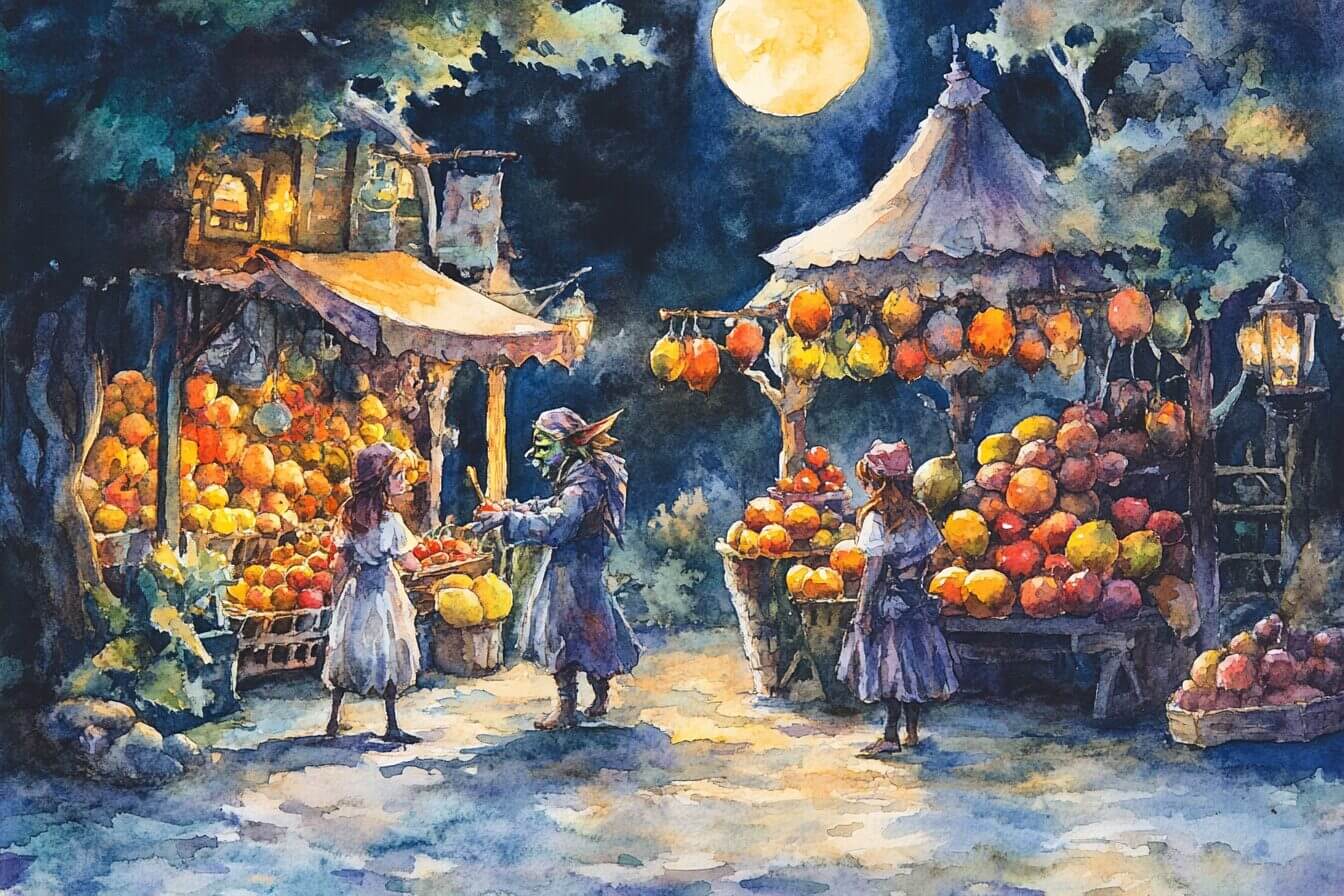
  • Transforming A Goblin’s Fruit

    Transforming A Goblin’s Fruit

    Content Notes: Discussions of Anti-Semitism, Classism, Colonisation, Misogyny and Rape

    Last time we discussed the history of Christina Rossetti as well as the period she grew up in. Now we will look at the way Anglican theology is baked into the foundations of Goblin Market. As well as the issues of Victorian Anglicanism that seeped into Rossetti’s work.

    Consuming Women

    Although pop culture of Victorian England regards the period as a time of almost hyperbolic prudishness, historical and literary analysis reveals a more contradictory picture. Mary Carpenter states there was a pervasive culture of sexually marketing women, whilst advising young girls to never become so slovenly and lustful.[1] She states that writing within this time period, as well as cultural consciousness generally, contrasted the women who fell to such desires against the pure untainted maidens. This becomes intriguing when we consider how Rossetti describes the sisters after Laura has partaken in the fruit of the goblin market:

    Like two blossoms on one stem,

    Like two flakes of new-fall’n snow,

    Like two wands of ivory.”[2]

    Instead of viewing Laura as inherently tainted, weaker or more morally bankrupt, Rossetti chooses to emphasise the similarities between the two sisters. Furthermore, Carpenter compares Rossetti’s opinions on the fall of Eve with the “fall” of Laura. [1] She states that in both cases, it is to do with their virtues of boldness but lack of guile that results in their respective downfalls. This does lead to a essentialising of feminine behaviours, but still reflects a more empathetic lens and certainly better than the pervasive opinion (then and now) of women’s inherent feeble mindedness. Additionally, this suggests Laura’s issues are as much a trap of a vicious sexist society as they are a fault of her own personality traits. And she is not the only one entangled in the trap of misogyny.

    Whilst Laura’s peeping results in her succumbing to temptation, we can see how resisting the Goblin Market leads to issues for Lizzie. Initially, it is as straightforward as the denial of the hedonistic delights that Laura gets to indulge in. Lizzie must remain eternally vigilant against the notion of pleasure or else succumb to a stupor.[1] This plight of Lizzie is doubled down when she ventures to the market and her resistance is punished. The attack by the goblin men is vicious, even though it starts with mere insults. Soon it escalates to scratching, biting and attempted force feeding of fruits, in a scene of metaphorical rape.

    This assault all starts because Lizzie wishes to buy the fruit with a silver coin and refuses to partake in a feast with the goblins. One can regard this as an angering of the sexual market, the commodification of sexuality for the dispensation of women. Because Lizzie acts with temperance and is in some ways protected by possessing money, a representation of status and power, the alluring tricks of the Goblin Market fail. Lizzie is gifted with some guile and luck, therefore the market assails her, attempting to force her into a similar position as Laura. So that she may experience the emptiness her sister does.

    Goblin Market (2017) by Omar Rayyan
    Retrieved From: MV Times

    But we can take this on step further. The exotic fruits do not originate in Britain as there are “citrons from the south” and it is said “men sell not such in any town”. [2] These are colonial exports, luxuries unimaginable to the working class who would have raised a brow at a banana. These are fruits people could not access with a pittance and therefore would turn to other avenues. Carpenter interprets the act of Laura trading her golden locks as a stand in for how women, and girls, bargained their bodies for access to luxury. [1] In this light, it is a metaphorical stand in for sex work and the bartering of bodies to receive goods.

    So, we can understand Rossetti’s framing as favouring the redemption of fallen women. Specifically, she encourages the acceptance of destitute women, championing amelioration of their exploitation. And this does fit with the history, Rossetti was part of a sisterhood that catered to the lower class. [3] Even if All Saints Sisterhood did not exclusively cater to sex workers, it is likely that those who volunteered would come into contact with them. Because any long term help for the impoverished will inevitably have to help those who turn to selling their bodies. Rossetti was able to witness the victimisation and horror these women underwent to survive. And the power of sisterhood, to assist those in dire straits.

    Sisterhood and Rossetti

    The prevailing Anglican narrative in Rossetti’s time for men and women, consisted of an innate gender binary. Men were to save; women were to provide for those who saved. In some ways this was mirrored in one of the most vital relationships within the Bible, that of Jesus and his mother, Mary. Jesus, the man, is the closest to God and so only he can bring about the saving of those who have sinned. Whereas Mary can only support and nurture as a maternal figure.

    However, as Janet Casey points out, this dominant narrative did not go unchallenged. Many women of the time period saw themselves more in Jesus than in Mary because, due to the Fall of Eve, they too were born to suffer. [4] Florence Nightingale viewed herself as a female Christ, believing that women’s role as nurturers could take on heroic status. A belief shared by Rossetti, who said of maternal love that it makes a mother:

    “Not a giantess or heroine, but at once and full grown a hero and giant”.[5]

    We can see the heroism of feminity within Goblin Market, as Lizzie is motivated to act by Laura’s suffering and in turn suffers to redeem her sister. An act that usually would be seen as masculine instead leads to the exaltation of feminine care and love, especially when it is directed to other women in sisterhood. It is not a breaking down of these binaries in the modern sense but more of a restructuring. This was typical for feminist thought of the time period, emphasising that women’s roles did not mean they should be perceived as lesser in capability and dignity.[4]

    As well, we have talked about how both Laura and Lizzie are trapped within the confines of gendered expectation and the sexual market. But as Casey argues, both too offer redemption from this feminine suffering.[4] Lizzie through the Eucharistic redemption the fruit offers Laura, how sisterhood and togetherness can be healing. Laura through exhibiting courage that Lizzie replicates when venturing into the Goblin Market, which leads to spiritual prosperity. The pair work together to help foster growth in one another, showing the redeemer can be redeemed and vice versa. Thereby, breaking down the narrow expectations for women to be the passive role.

    The Goblin Market (1984) by John Bolton
    Retrieved From: Kristo Kai on Twitter

    However, I would like to explore a grimmer side to the ideal of sisterly redemption through suffering. Because this rhetoric inevitably leads to the glorification and acceptance of suffering as character growth. These are not horrific experiences that will scar the person for the rest of their life, but rather challenges to be overcome to gain inner strength. Rossetti never dwells on the violation that Lizzie and Laura experience throughout the course of the poem. Instead restoring both sisters to their former innocence and imagining a picturesque future for them.

    In isolation, this is not dreadful and makes sense given how much of the tale relies on the redemptive powers of the Eucharist and sisterhood.

    But considering how much of this tale is linked to the sisterhood where Rossetti worked at. To the idea of healing the spiritual ills of the impoverished and dispossessed. It inevitably comes across as rather detached and unhelpful. Though Casey argues that both sisters redeem each other, only Lizzie with the silver coin, a sign of wealth, takes on the Christ-like mantle. Which, in my opinion at least, ends up feeling like a classist saviour narrative that was all too common within English culture at the time. A narrative that extended to colonialist practices the country continues to enact.

    In this way, Rossetti is not challenging the stories of the time. Instead she feebly is stating that women can do it too, in an attempt to envelop richer white Anglican women into the dominant class that decide how and who to redeem. A tactic still in use to this day.

    Eroticism and The Eucharist

    As talked about in the previous post, the Oxford Movement within the Anglican Church was (amongst other things) pushing for a significant revision of how to understand the Eucharist. Both in terms of how tangible God’s presence was in the bread and wine, as well as the effects of the ritual itself. As Marylu Hill describes, writers of the movement believed the Eucharist led to a satiation of a spiritual hunger. [3]

    Within this framework, people are born with a innate yearning for a union with God, to be a part of his hallowed pasture and become one under him. Hill argues that our desire to satiate such starvation is central to Rossetti’s Goblin Market.[3] Laura especially hungers for the fruits of the market, but in turn finds they do not satiate her needs. It is only when taking communion with Lizzie, our Christ-like redeemer, that she becomes filled.

    But, in framing her story this way, Rossetti establishes a fundamental distinction to her peers. She never says women should not partake in any of the feasts they experience around them. Instead, she focuses on what would best satisfy the hungers they feel. [3] We can observe this in the contrast between the fruit of the Goblin Market and the partaking of Lizzie by Laura. In the former, the focus is on decadence and consuming until you can eat no more. Not out of satiation, but tiredness from the sheer act of irreverent ingestion. But when she partakes in the fruit of Lizzie, there is a bond between the devoured and the one devouring, a connection that stuffs and sustains. A tangible filling of the emotions and body, that results in a complete satisfying of desires and a return to former innocence.

    And this union is absolutely erotic. According to Hill and Casey, there is a deliberate intermingling of the transcendental experience of the Eucharist and the corporeal thrill of getting off. [3][4] Because writers at the time, like Edward Pusey, emphasised the eroticism of the Eucharist:

    “This Body hath he given to us both to hold and to eat; a thing appropriate to intense love. For those whom we kiss vehemently, we ofttimes even bite with our teeth…Even so Christ hath given to us to be filled with his Flesh, drawing us on to greater love.”[3]

    The emphasis on kissing and biting, as well as being filled with Christ as intense love is a particularly interesting mirror to Goblin Market. As it too focuses on the act of biting, suckling and other oral activities. This is to the point that many a psychoanalytic perspective on the nature of devouring under Freudian psychology has been written. But those, to me at least, miss the mark for a more clear and frankly kinkier interpretation.

    Rossetti is demonstrating the inextricable link between the divine and the mundane. Something necessitated by Oxford Movement doctrine, where God’s Word is transformed from unintelligible divinity into digestible material through the Eucharist. In creating the Eucharist, God is acknowledging the importance of earthly bodies and their tangible responses. Whilst Anglicans should seek to transcend their mortal forms, the desires of such bodies are integral to the religious experience.

    Goblin Market (1910) by Florence Harrison
    Retrieved From: Facebook

    In this way, the raw ecstasy of Laura feasting on Lizzie’s juices is about marrying the transcendental and the mundane. It is not by one or the other that a person such as Laura can commune with Christ (or Lizzie). But through the combination of both aspects that one will achieve an almost orgasmic height of a spiritual awakening and salvation. [3]

    As well, by focusing on the eruptive experience of Eucharistic redemption, Rossetti is describing the throws of ecstasy that can be offered on a spiritual level. But only when connected to a material form. The erotic undertones are not necessarily that of desire between the two sisters but rather bodily processing of spiritual experience. By presenting this, Rossetti is showing the link between the two parts of a person. Their body and spirit. As well as how both can influence one another.

    Through the devouring of mortal foods, both the body and soul are left barren, to waste away. Through divine food, ingested by the corporeal form, the incorporeal can experience enlightenment which translates into the physical as otherworldly delight. This allows the soul and the body to be rejuvenated, not just into a new superior form, but to return to past Edenic ideal. An ideal that has escaped mankind since the fall of Eve. It is esoteric and ephemeral to grasp, but there is genuine beauty in the ideas Rossetti is attempting to capture.

    It’s a shame it is only for certain groups of people.

    Anti-Semitism Is More Than Goblins

    To understand the antisemitism at play in Goblin Market, it is first important to comprehend the underlying bigotry in Victorian England and how it pertained to Christina Rossetti. As reported by Cynthia Scheinberg in her excellent book on the Jewish identity in Victorian poetry, the predominant Anglican interaction with Judaism, was appropriation of its texts.[6] And I do mean appropriation, the figures of Jewish scripture were transposed and warped to fit Anglican narratives.

    Mother of Moses (1860) by Simeon Solomon
    Retrieved From: ArtNet
    Note: This is an image of Jochebed (Left), Miriam (Right) and Moses (Baby). It was the only piece I could find containing Miriam painted by someone Jewish

    For example in Aurora Leigh, written by Rossetti’s peer Elizabeth Browning, there is use of the Hebrew figure Miriam.[6] Miriam is an prominent person within the Hebrew Bible, being the elder sister of Moses and a major prophetess, but possessing significantly less importance in Anglican theology. However, the poem transforms her from a leader of the Jewish women out of Egypt, to the proclaimer of virtuosity for Anglican women. In this way her religious and ethnic identity is wiped to bolster the ego of the dominant religion.

    This on it’s own sounds pretty harmful, but gets worse when you understand more historical context. Judaism was, and still is, a persecuted minority ethno-religion. That is a religious movement with inextricable ties to certain ethnic groups and cultures. At the time Rossetti and Browning were writing, Jewish people were not allowed to be representatives in parliament.[6] Additionally, they were constantly under pressure by Victorian culture to convert. Organisations like the Society for the Promotion of Christian Knowledge (SPCK), were missionary agencies with the goal of promoting Anglican values. By which I mean coercing individuals to convert, including Jewish people. An organisation that Christina Rossetti was not only a part of but wrote for as her book, Seek and Find was published through it.

    Not only this, but there are two poems which Scheinberg points to as typifying Rossetti’s antisemitic views.[6] “By The Waters of Babylon. B.C. 570” and “Christian And Jew”. The former reimagines the Jewish narrative of their exile from Babylon, using the Book of Lamentations. In the original scripture the point of view figure, Jeremiah, weeps for his kinsmen as their plea to be saved is unheard by God. But he also provides hope and security in the knowledge that all will be forgiven and the Jewish people will be able to commune with God in time.

    The Lamentations of Jeremiah by
    Fritz Eichenberg
    Retrieved From: filozofskoteoloski

    However, in Rossetti’s version, there is no hope for their redemption in the eyes of God. Like the Babylonians, the Jewish culture not only has fallen into the annals of history but should remain there.[6] Because the scriptures of Judaism are superseded by that of the Christians. This goes so far, that Jeremiah (like Miriam) is transformed from a Jewish figure, into an Anglican one. Becoming a prophet for the eventual arrival of Christ as a Lord and saviour. A belief not held in traditional Jewish theology.

    This trend is maintained through, “Christian and Jew” which features a dialogic narrative between representations of the two religions. The Christian is viewed favourably, able to see and hear the beauty of Heaven, whilst having the agency to sing for the Lord himself and spread his word.[6] Whereas the Jewish stand-in is impotent in spirituality, unable to see paradise and relying on the Christian to truly recognize God. Moreover, the Jewish figure is passive, unable to act and simply is there to receive the proselytisation of the Christian. In other words, Rossetti views Christianity as the only possible connection to God.

    With all of this, we can see how Rossetti views Judaism and the Jewish people. As historic. A history that is best forgotten about or overwritten, with the more enlightened Anglican narrative guiding any and all scripture it can steal. As well as positioning the Jewish people as unable to commune with God, needing the patronising saviourship of the Anglicans to become true believers. And this belief bleeds into Goblin Market.

    A Closed Off Market

    Scheinberg contends that the fruits on offer at the Goblin Market, are not just stand ins for the sexual marketplace or the emptiness of mortal carnality.[6] But rather the words of the Hebrew Bible. The phrase that opens Goblin Market is a reference to Isaiah 55, where Isaiah implores the people to come buy the wine and honey of God. Suggesting a marketplace that offers spiritual sustenance for the Jewish people from God. And as shown previously, it would not be the first time Rossetti cribbed from Tanakh, to create warped comparisons.

    Goblin Market (1933) by Arthur Rackham
    Retrieved From: British Fairies

    In this interpretation, the fall of Laura is not an analogue to Eve, but rather a representation to a more contemporary issue for Rossetti. The temptation of the Jewish scriptures for poor innocent Anglican girls. A theology that promises succulent fruits and delights, but offers no spiritual satisfaction.[6] Abandoning those tempted by it to be eternally wanton. This can then be linked to our previous discussion on the Eucharist. As the hollow food offered by Victorian society is now replaced by the malnutrition of the Hebrew Bible.

    We can even witness how some of the effects of Laura’s torment reflect Rossetti’s view of Judaism:

    “Her hair grew thin and grey;

    She dwindled, as the fair full moon doth turn

    To swift decay and burn

    Her fire away.”[2]

    Laura ages quickly and dwindles as time passes, an echo of Rossetti’s view about Jewish beliefs. As decrepit and decayed, the fire that once ignited them with divine passion, now burnt out after their exile from the Lord. Furthermore, Laura dreams of a desert-like oasis, filled with luscious fruit she can at once imbibe.[2] A paradisal garden compared to her current state of complete desolation, yet still a barren dream, harkening back to imagery of Jewish exile. The description feels eerily reminiscent of those presented in Rossetti’s more blatantly anti-Semitic poems.

    Furthering this, the Eucharistic act between Laura and Lizzie, is not solely redemption from the ills of man. But can be viewed as scene where the carrier of Jewish religion is transformed into a state of innocent Anglicanism. As Scheinberg notes, the use of wormwood to describe the burning sensation Laura feels, has parallels to Lamentations.[6] In it, wormwood is used to allude to the pain suffered by wrath of God as well as the punishment of false prophets. Therefore, we can suppose Laura is experiencing the wrath of God and being punished for the consumption of erroneous beliefs. A belief that must be purged from her blood.

    And this redemption of Laura comes from Lizzie transforming the fruits of the goblin men, the scriptures of the Jewish faith, into Anglican evangelism. The fruits that drag her sister into unrecognisable cataplexy, become the antidote because Lizzie embodies an Anglican Christ. It’s hard not to interpret this as an almost masturbatory self-congratulation of Rossetti’s own work. Of her ability to transform the heathen Jewish scriptures into divine Christian panaceas. That Lizzie is a self-insert of Rossetti in more ways than one.

    But even if you do not buy Scheinberg’s framing, there is undeniable appropriation of Jewish theology for an Anglican poem. Even with the benefit of the doubt, a benefit I do not believe Rossetti worthy of, her poem extends Anglican writer’s general trend of reappropriating Jewish texts. Of using a marginalised people’s beliefs when convenient, then side-lining their opinions or humanity. Because even if we accept this as a more generalised Anglican narrative. It joins a litany of works like it, that frame Anglicanism as the sole legitimate redemptive religion. A marketplace of spirituality that will only save someone, if they revoked their deeply held beliefs and ethnic identity. All for the sake of pleasing a saviour complex.

    Combining a Dual Nature

    In the closing of this analysis, I wish to provide a relevant quote from Scheinberg, within her book:

    This idea that anti-Semitism can be a tool for generating complex artistic texts is a useful way to move past the idea that so-called “great art” cannot contain deeply problematic ideological content.”[6]

    Rossetti’s Goblin Market, is not solely a tale of feminist emanciptation and the power of sisterhood. Rossetti’s proximity to power through her wealth and devoutness leads to her uncritically accepting some of the worst bigotry of her time. The fight of first wave feminism is in many ways, reflected in the dual nature of Goblin Market. There is an emphasis on women as equals to men, as able to help within society in their own unique way. But there is equally silent emphasis in those left out of such rhetoric, in the types of women considered to be worth redeeming.

    It is critical that we recognise the sisters left out of such sisterhood, in the exemption of the experiences that lay outside Anglican views. Rossetti deliberately leaves out the perspectives of those who she does not believe to be worthy of saving and instead writes of them disparagingly in her other works. Her devout religiosity is what lends this text such depth and beauty. As well as what makes it warped and disgusting.

    I will not advise you how to feel about this poem. My own feelings are incredibly complex, and I do not know if I will ever reach a resolution. But I implore you to sit with the ramifications of this and other pieces of art. To consider how these frameworks might alter your understanding of the most lauded creations. It is only in completely dismissing critique and analysis of the media we enjoy, that we fail to genuinely cherish and appreciate it. In idle acceptance of art, we deny ourselves the opportunity to satiate our curiosity and satisfy our souls with the complexities of human creation.

    Thank you for reading, I would love to see all your thoughts about the religious themes of Goblin Market. Tune in next fortnight, where we will be dissecting the more modern and sapphic interpretations of Goblin Market. Until next time.

    References

    1. Carpenter, M. W. (2017). ‘Eat Me, Drink Me, Love Me’: The Consumable Female Body in Christina Rossetti’s Goblin Market. In Victorian Women Poets (pp. 212-232). Routledge.
    2. Rossetti, C.G (1862). Goblin Market and other poems. Cambridge London. Macmillan.
    3. Hill, M. (2005). “Eat Me, Drink Me, Love Me”: Eucharist and the Erotic Body in Christina Rossetti’s Goblin Market. Victorian Poetry, 43(4), 455–472.
    4. Casey, J. G. (1991). The Potential of Sisterhood: Christina Rossetti’s” Goblin Market”. Victorian Poetry, 29(1), 63-78.
    5. Bell, M. (1898). Christina Rossetti: A biographical and critical study. T. Burleigh.
    6. Scheinberg, C. (2002). Women’s Poetry and Religion in Victorian England: Jewish identity and Christian culture. Cambridge, UK .
  • Constructing A Goblin Market

    Constructing A Goblin Market

    Content Notes: Discussions of Colonisation, Homophobia, Incest, Pathologisation of Women, Sexual Assault and Rape

    Christina Rossetti’s Goblin Market is a classical piece of feminist poetry. Admired by many women, especially with the rise of second wave feminism, it has spawned numerous intellectual discussions about the experience of femininity in Victorian England and beyond. It was also quoted in one of the best episodes of modern Doctor Who, which is how I initially came to learn about the poem. So join me, as we take a peek into the historical context behind the Goblin Market.

    The Beginning of A Market

    Christina Rossetti was born in 1830 within London. [1] Her father, Gabriel, was a well-known poet and her mother, Frances, is most known for being related to famous people, according to Wikipedia.[2] Her family was filled with creative people, like her uncle John Polidori who wrote The Vampyre, considered to be one of the first modern vampire story. [3] She was somewhat of a prodigy, being first published at the age of 12, proving that anyone can be an acclaimed pre-pubescent author. If you have a grandfather with a publishing company. Truly the Christopher Paolini of her time.

    Goblin Market was published in 1862, although drafts had been being made in at least 1859.[4] I am going to provide a brief overview as to the plot, and will have snippets where necessary, but I encourage you to read it in full. Like all poems, the experience of reading Goblin Market add to the perspectives and will provide necessary context for interpretations. If reading is not your style then there is an audio version of the tale featuring excellent voice acting by Shirley Henderson.

    Portrait of Christina Rossetti (1877) by Dante Gabriel Rossetti
    Retrieved From: Apollo Magazine

    Our story begins with two sisters, Lizzie and Laura. They live in a small Edenic cottage, isolated from the larger cities around. One day, as the two are venturing out, they hear the sounds of a goblin market in the woods nearby. Although Lizzie resists the sumptuous temptations, Laura is enamoured with the burgeoning fruits, despite her sister’s protestations. Laura indulges in the culinary delights; each described with lurid eroticism. All for the small price of a lock of hair. She eats till she can eat no more, stuffed and unable to tell night from day, before heading back to her Lizzie.

    However, as time passes Laura becomes increasingly withdrawn. The first night without the fruits, she stays awake, gnawing and gnashing at the idea of the delights. She tries growing a seed from the leftovers of the goblin market but it never sprouts. Ultimately, Laura becomes completely devoid of life, her hair growing grey and overall is passive in demeanour. Worst of all, though Lizzie can still hear the goblin market, her desperate sister cannot. Lizzie is unable to bear this any longer. Therefore with a silver coin in her purse, she goes to the goblin market to obtain some fruit for her sister.

    The trip is not as easy as she would like. At the start, the goblin men try enticing Lizzie to partake in a feast, though she is steadfast in merely wanting to buy fruit. The goblin men then hurl insults at her before resorting to assaulting Lizzie. The attack is portrayed a form of metaphorical rape, because although she is never sexually defiled, the description of the violation is carnally coded. Lizzie remains stalwart, never partaking in the fruit even as the juices drip onto her face. Eventually, the goblin men give up, throwing Lizzie’s silver coin back at her. Lizzie then runs back to her sister.

    Goblin Market (1933) by Arthur Rackham
    Retrieved From: Apollo Magazine

    The revival of Laura is also quite sexually charged, but is much more rejoiceful. Lizzie bursts into the house, filled with ecstatic delight as she encourages her sister to:

    “Eat Me, Drink Me, Love Me”[5]

    Whilst the sisters never perform a wanton act, the two are in the throws of ecstasy. On top of which, Laura feels intense pain intermingling with her delight. They slurp and lick and bite and kiss, partaking in each others bodies like fruit. But after this trial, Laura is rejuvenated, transformed back to her old self once more. The sisters celebrate, with the poem ending by mentioning the two girls have become wives and Laura telling her kids the value of sisterhood.

    There are many places one can begin needing to explain historical context, but the most important is likely the part that flies over the head of most people. That is unless you know “Eat Me, Drink Me, Love Me” is a reference to the Eucharist. Don’t worry I didn’t either until three papers in. When it was explicitly stated. Even though two of the papers employed the phrase in reference to religious interpretations.

    But to discuss the religious roots of this poem in a later essay, I am going to have to talk about some history now.

    Devouring Christ

    Anglican is the term used to describe the Church of England, that is the majority religion of the UK. It was conceived after Henry VIII decided commitment was overrated and wanted to acquire a new wife. Lamentably, the Catholics rather despise the idea of divorce, so Henry VIII made his own denomination. This Church of England constituted part of the larger Protestant Reformation, which would require an entire essay to accurately dissect. All you need to know is England wasn’t the only one breaking away from the Italian church. Also, to my UK readers, I am going to use Anglican for ease instead of Protestant to refer to the Church of England and its adherents. Because although British Anglicans call themselves Protestants, that term comprises multiple subsections of Christianity.

    When Christina Rossetti was writing, the Anglicans had been stable in England for a good 200 years. Minus that time we became Puritans and the Anglicans were banned. As with all religions, they began to be bored of the traditions they used. Specifically a movement called the Oxford or Tractarian Movement was brewing.[6] The Oxford Movement was spearheaded by some of the higher ups in the English Church, who believed Anglicans should move to a more Catholic oriented view of theology. It originated in a series of essays called “Tracts for The Times”, hence Tractarian. This resulted in the Anglo-Catholicism movement, which was a melding of the two worlds, as well as some Anglicans diverging to the Catholic Church.

    The Last Supper, Restored (1495–1498) by Leonardo Da Vinci
    Retrieved From: Wikipedia

    However, the crucial point of contention that is of interest for us today is the Eucharist. This is when a person eats the Body of Christ and the Blood of Christ in the form of bread and wine. Or if you are a child, Vimto. The Eucharist comes about due to a section of the Bible called The Last Supper, where Jesus and his disciples eat bread and wine. Though accounts differ depending on which section of the Bible is recounting the story, emphasis is placed on the holy connection between Christ’s material form and the meal. In common Christian theology, Paul (one of Jesus’ disciples), then insitutes the Eucharist as a ritualistic celebration of God. But, because of differing accounts and time between the Bible’s writing and Victorian Anglicanism, there emerged two Anglican interpretations of the Eucharist.

    First is Virtualism, the idea that presence of Christ in the bread and wine is purely spiritual and possessed no bodily substance. [6] Put differently, they are not consuming Christ’s body in any tangible way, but instead through the Eucharist are filled with the spirit of God. Conversely there was Receptionism, which focused on the worthiness and goodness of the person partaking in the Eucharist, as opposed to the food. In this way, God uses the bread and wine to commune with the person, so they otherwise intangibly recieve the Blood and Body of Christ. These two are clearly offering a more intangible (and frankly esoteric) interpretation of the Eucharist. But The Oxford Movement subscribed to another view.

    To express it simply, they believed that when someone performed the Eucharist, they were eating the Body and Blood of Christ .However, it is not a straightforward case of psudeocannibalism. As Marylu Hill describes, the belief by Anglicans within the Oxford Movement was that the bread and wine represent God’s words made digestible to humans. [6] Practitioners at the time compared the Eucharist to breastfeeding mothers. Like a mother transforms food into milk for her baby to feed, so too does God formulate his love into a digestible form. Essentially, the bread and wine, were both materially food as well as the Body and Blood of Christ. They profoundly believed the Eucharist was soul food in a literal sense, capable of redeeming those who had lost their way.

    But even more so, the Eucharist satiated people’s spiritual hunger. Around this time, many Anglican theologians were looking back at early Christian writers and being inspired by their works. And these works focused frequently on how the teachings of God, could satisfy the hunger of people in a way nothing else was able to. Edward Pusey, an important Anglican Theologian, focused on translating and teaching these interpretations. [6] In his translation of Saint Augustine’s writing is the following:

    “But I hungered and thirsted . . . after Thee Thyself, the Truth . . .yet they still set before me in those dishes, glittering fantasies. . . .Yet because I thought them to be Thee, I fed thereon; not eagerly, for Thou didst not in them taste to me as Thou art; for Thou wast not these emptinesses, nor was I nourished by them, but exhausted rather.”[6]

    From this we are able to tell that Saint Augustine, and by extension the Oxford Movement Anglicans, believed the world was teeming with fantasies that one can feed on. But those material indulgences are nothing when compared to the word of God, to his spiritual food that can fill our every want and desire. As I will talk about in the following essay, Christina Rossetti was absolutely inspired by Eucharist debates of the time. But first, lets get more specific about Rossetti’s Anglicanism.

    Devoting Time

    The history of Christina Rossetti is a relatively challenging thing to piece together. As reviewed by Mary Carpenter, the poet’s life around the time of Goblin Market is mostly relayed through her brother William. Unluckily, for us, William did not retain the most accurate recollection. He failed to recall the separate orders his sister Mary joined and did not know when Christina began carrying out social work. [4] Consequently, take the specifics of her with a pinch of salt. Furthermore, we will have to talk of the general institutions she was a part of since there is little reliable information on her personal life.

    Christina Rossetti was involved consistently with her church, Christ Church, which she joined in 1843. [6] At some point before 1859, she began volunteering at the sisterhood adjoined to the church called All Saints Margaret Street. These sisterhoods were institutions for middle class Anglican women to volunteer and devote time to serving the working class. They were not religious orders like a nunnery, but rather open to all women who attended the church. Whilst some would focus explicitly on sex workers, All Saints seemed to utilize a more generalised approach. By the end of the 1860s, All Saints would have: an asylum for older women, an industrial school for girls, an orphanage and a nursing service.

    Portrait of Edward Pusey (~1875) by Rosa Corder
    Retrieved From: Art UK
    Fun Fact: Rosa Corder allegedly made forgeries of Dante Rossetti’s art (Christina’s brother)

    The church itself was a hotbed for social reform as well as for the Oxford Movement. Edward Pusey preached and lectured multiple times whilst Rossetti was known to attend the Church. So, as Mary Carpenter states, it is not unlikely she was exposed to these contemporary ideas.[4] Moreover Pusey was a significant proponent of social work through sisterhood, having been integral in the creation of All Saints. Although in Carpenter’s view, he saw the sisterhood as:

    A sanctified domestic enclave of perpetual daughters”[4]

    To put it in simpler terms Pusey, and many men like him, viewed these sisterhoods in a rather patronising and patriarchal lens. The volunteers of All Saints, including Rossetti, were viewed by the higher ups as youthful innocents who’s religious purity would help to liberate fallen women.[4] But this perceived purity, also resulted in many male liturgists fearing for these sisterhoods. Some worried that by being exposed to sex workers, these women would rebel against their roles as subservient humble wives to men. Since sex work began through small rebellions against God, these middle class women would also fall into the same vices. An idea with a substantial basis in reality. [No citation found]

    Those fears were part of a broader trend in English culture of disgust towards sex workers. The Contagious Disease Act of 1860, was the epitome of this fear, as it controlled and criminalised certain sexual activity due to worry over “degenerate hereditary” and syphilis.[4] Naturally, this was typically implemented against women’s sexuality, especially marginalised women. If you want to know how close to home that was for Christina, her brother Dante wrote a poem called Jenny. A poem which espouses the fear of sex workers diseased minds and contagious environments:

    For is there hue or shape defin’d

    In Jenny’s desecrated mind,

    Where all contagious currents meet,

    A Lethe of the middle street?” [8]

    But for the women working in these sisterhoods, it was a contrasting experience. The idea of social work sisterhoods originated with Florence Nightingale. Nightingale was a British nurse in the Crimean War, a war between Russia and France, with Britain allying with the French. All British people take a moment to expel your disgust. She was most known for her radical medical changes to wartime treatment, including insistence on cleaning the hospital barracks and disposing of waste products. Regrettably, these were revolutionary ideas for the time. Amongst these was another revolutionary idea, this time a more feminist one. The idea that women, even those who were unmarried, have worth in providing aid to people that cannot provide for themselves. Primarily if they work together in sisterhoods.

    Photograph of Florence Nightingale (1860) by Henry Hering
    Retrieved From: Wikipedia

    Nowadays, this idea can seem somewhat milquetoast, but it faced considerable backlash. Men at the time warned that single women working, especially together, would result in them being displaced from their “natural” position.[4] Additionally, this displacement would not just be unacceptable for sub-par men, but would also cause the fall of the British Empire! How awful, indeed. The idea that women can work together to uplift and transform the world, established such an impression on Rossetti that she tried to join Nightingale. And she was only turned away because she was too young. The idea of sisterhood and women being the ones to save each other, is evident in Goblin Market from even the most cursory glance.

    However, I do want to conclude this section with a little bit of a reality check. Whilst these sisterhood orders, secular and religious alike, were revolutionary for the time. Do not misinterpret them as perfect bastions of care. To begin with, the emphasis of spiritual healing is an extension of common colonialist practices at the time. That through God (only the Anglican one, though) people can be made whole. And so, we should ignore or override other people’s spiritual and religious beliefs. Even more secular institutions can be rather impotent to soothe individuals mentally and spiritually, if it fell outside their view of Christian values. As well Anglican values were often weaponised against the people Britain colonised, usually as an excuse to not assist them. Or to only aid them with the condition of nominally appearing Christian.

    In addition, this was an inherently classist system as it was always middle class Anglican women performing the care. And I am not against the prosperous devoting time and money to helping those less fortunate. However, these institutions perpetuated dehumanising rhetoric and did not allow the people most disadvantaged to have a voice. This is what led to elderly people being locked away in asylums for the crime of aging, or young girls kicked out of their only shelter for normal childhood behaviour. Never mind the mistreatment or lack of empathy given to those with disabilities. The sisterhoods did promote class understanding, but only on the basis of the established culture in Victorian England. Not to directly challenge it at multiple intersections.

    Sappho’s Sisterhood

    It is inevitable in Goblin Market to consider comparison between the distinctive tones of eroticism within separate scenes. With Laura and the goblins, the focus is on excess, on devouring until you are incapable of doing so any more. With Lizzie and the goblins, it is on spiteful hatred and violence enacted against her. And when the two sisters are together, it is treated as painful but beautiful and filled with rejoicing. Since the latter section is the one most positively described by the narrative, many have inspected this through a sapphic lens. That is to say, what if Laura and Lizzie were intended to represent gay lovers?

    Whilst I will not go into detail about the different homosexual interpretations available today. I do want to provide some history to Victorian lesbian views and how we can understand lesbianism in literature from oppressive cultures. And Victorian Britain was indeed oppressive to lesbians. Contrary to popular belief, as written by Jonathon Hay, the Victorian culture regarded sapphics with great disgust.[9] Whilst any woman who had an ounce sexual desire could be regarded as a nymphomaniac, lesbians in particular represented:

    the great damage of young girls and neuropathic women”[10]

    Indeed whilst gay men faced the brunt of the criminalisation and pathologisation, women, and especially women who loved other women, were not immune to being pathologised. For an apt and timely comparison, think about how in modern day Britain, trans women are a major target of transphobic institutions and rhetoric. But this does not lessen the discrimination faced by trans men nor would one say that British society is more forgiving or kinder to them. Because ultimately, the hope is that by targeting one, all others within a similar umbrella will be equally persecuted. It is just more politically convenient to target certain groups.

    The homophobia within British society was so severe that Hay recounts a lesbian couple in a boarding school, who hid their relationship in plain sight.[9] Instead of being physically intimate or even speaking to one another, it was through non verbal gestures and movements of their eyes, that love was indicated and reciprocated. Hardly the hallmark of a society with a passive view of women’s homosexuality. Even famous lesbians of the time period like Anne Lister, felt the need to hide their indiscrete rendezvous with other women. Because if they didn’t, there would be societal backlash or institutionalisation.

    Carmilla by Joanna Ostrowska
    Retrieved From: Artstation

    So there should be no surprise that any literature of the time that wished to have sapphic characters would have to hide or alter the homosexuality. For example, in Carmilla by Sheridan Le Fanu, the lesbian relationship is masked by the monstrousness of the vampire Carmilla and her eventual death. Essentially, killing off the active lesbian to not seem too supportive as well as portraying her as inhuman and predatory for her sexual desires. With Goblin Market, Hay argues the obfuscation comes from the inherent incestuousness of the relationship, as well as the ending making them return to heterosexual bliss. [9] By doing so, any homosexuality is easily written off as metaphorical, and viewed as interpretive. Because no one is going to think that acts between sisters is meant to be perceived as sexual, especially when they return to the social norm.

    Now here’s the thing. I am not arguing that Rossetti intended for this to be sapphic in any of these essays. On the balance of what I’ve learned about Rossetti, she is deeply Anglican and certainly susceptible to the bigotry of the time. One of her poems literally glorifies the British colonisation of India and viewing Indians as savage rapists.[5] Therefore, it seems unlikely that she intended this to be a tale on lesbians. But her tale, whether she intended to or not, is very queer for the time.

    In centring feminine sexuality within a usually wholesome female relationship, she is countering narratives that taught women to hide and be ashamed of it. And by having sisterhood turn into erotic delight, she is making use of narrative tactics employed by lesbian writers of the time, to hide their homosexual desires and messaging. So if even unintentionally, the poem has a clear way of being viewed through a queer lens. Because it showcased woman on woman eroticism, without appealing to a male heterosexual audience. And that is an important step to make in writing and poetry for gay literature, even if it was not done deliberately. It helped inspire sapphic artists later on to make their work in this vein and to improve on the limitations. That inspiration should be acknowledged and treated with care.

    But, with all that being said, I hope you have enjoyed this deep dive into the historical context of Christina Rossetti’s Goblin Market. In the next essay, I will cover how Rossetti combines the religious and the transcendental erotic, within the poem. Thank you for reading! Until next time.

    References

    1. Academy of American Poets. (2019). About Christina Rossetti | Academy of American Poets. Retrieved From: Poets.org
    2. Wikipedia Contributors. (2025). Frances Polidori. Retrieved From: Wikipedia
    3. Little, R. (2020). Homoerotic Vampirism in” Goblin Market” and Carmilla. Furman Humanities Review, 31(1), 69-80.
    4. Carpenter, M. W. (2017). ‘Eat Me, Drink Me, Love Me’: The Consumable Female Body in Christina Rossetti’s Goblin Market. In Victorian Women Poets (pp. 212-232). Routledge.
    5. Rossetti, C.G (1862). Goblin Market and other poems. Cambridge London. Macmillan.
    6. Hill, M. (2005). “Eat Me, Drink Me, Love Me”: Eucharist and the Erotic Body in Christina Rossetti’s Goblin Market. Victorian Poetry, 43(4), 455–472.
    7. Casey, J. G. (1991). The Potential of Sisterhood: Christina Rossetti’s” Goblin Market”. Victorian Poetry, 29(1), 63-78.
    8. Rossetti, D. G. (1913). The Poetical Works of Dante Gabriel Rossetti, Ed. with Preface by William M. Rossetti.
    9. Hay, J. (2018). Queer Victorian Identities in Goblin Market (1862) and In Memoriam (1850): Uncovering the Subversive Undercurrents of the Literary Canon. Exclamat!on: An Interdisciplinary Journal, 2, 149-17277#
    10. G. Bouchereau (1880-1900). ‘Nymphomania’ , in Ledger, S., & Luckhurst, R. (Eds.). (2000). The fin de siècle: A Reader in Cultural History, c. 1880-1900. Oxford University Press.